
Executive Decision Brief
Fleet Fuel Cost Outlook
GulfStream Logistics
Focus Areas: Fleet Operations • Procurement • Risk Management
Illustrative Executive Decision Brief prepared for a fictional transportation & logistics company.
This example demonstrates how Magnolia Decision Advisory transforms market data into defensible executive decisions through scenario analysis, structured decision frameworks, and executive decision support.
Business Context
Organization
Industry: Transportation & Distribution Operating Region: 14-state regional network Annual Fuel Spend: $10.2M
Decision Context
Primary Exposure: Diesel fuel costs Decision Challenge: Managing fuel cost uncertainty while protecting margins. Planning Horizon: Next 6-12 months
Executive Summary
Business Challenge
GulfStream Logistics is experiencing increasing uncertainty in diesel fuel costs, creating risk around budgeting, pricing, and operating margins. Leadership needs a structured approach to evaluate potential market outcomes before making procurement and financial planning decisions.
Objective
Develop a decision framework that quantifies fuel cost exposure under multiple market scenarios and identifies actions that improve decision quality and reduce financial risk.
Decision Question
How should GulfStream Logistics adjust fuel procurement, pricing assumptions, and operational planning over the next 6–12 months if fuel prices remain elevated or become more volatile?
Key Recommendation
Current market conditions suggest maintaining existing fuel assumptions would expose the organization to material budget variance under higher-cost scenarios. Leadership should adopt a scenario-based planning approach, update procurement assumptions using defined market triggers, and monitor leading indicators through an executive decision dashboard. This approach strengthens decision quality by replacing single-point forecasts with defensible, evidence-based planning across multiple market conditions.
Executive Scenario Analysis
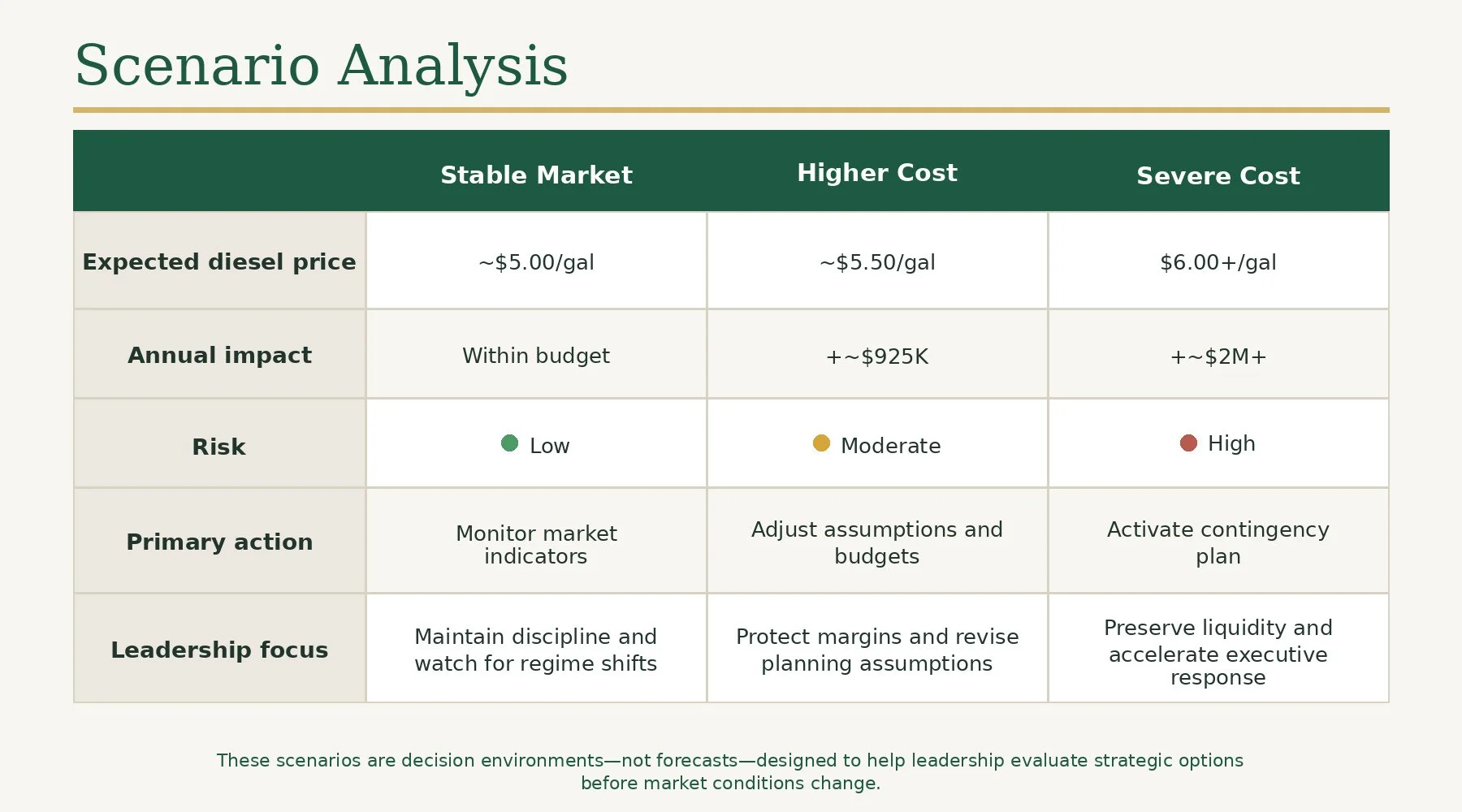
The table below summarizes three plausible market environments and their potential implications for leadership decisions. Rather than predicting a single outcome, this framework helps executives evaluate financial exposure, assess strategic risks, and identify appropriate actions before market conditions change.
Executive Decision Dashboard
The dashboard translates market data into executive decision support. Throughout the engagement, leadership can explore alternative market scenarios, evaluate financial exposure, and understand how changing assumptions affect strategic recommendations.
Sample Executive Dashboard
For the best experience, view the dashboard in full-screen mode on a desktop computer.
Decision Intelligence in Practice
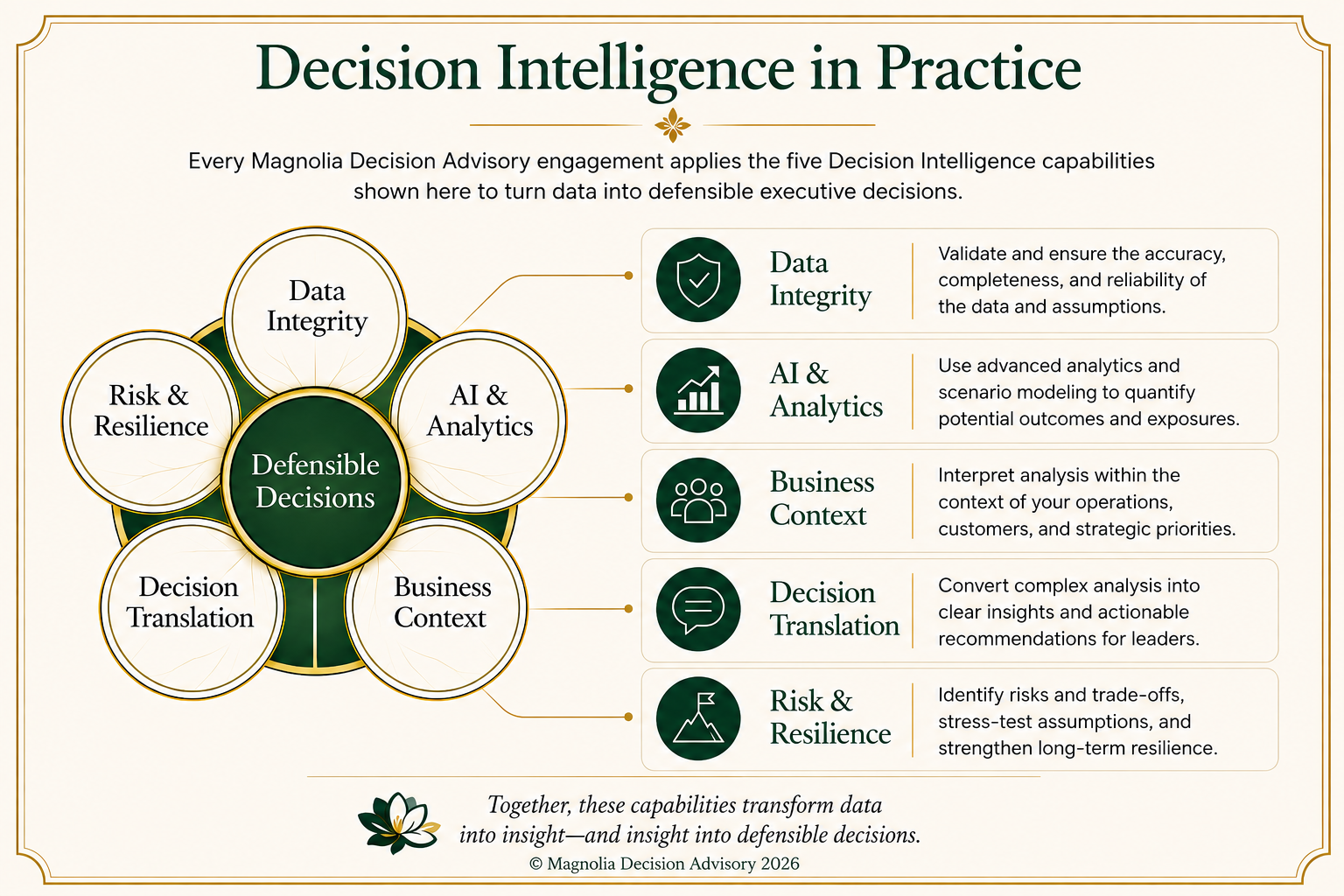
Every Magnolia Decision Advisory engagement follows the same decision framework. Rather than delivering analysis alone, each component is designed to improve the quality of executive decisions under uncertainty.
Key Risks & Trade-offs
Every decision involves trade-offs. Rather than optimizing for a single forecast, leadership should understand how each strategic choice performs under different market conditions.
Fuel Price Exposure
Sustained diesel prices above planning assumptions could materially increase annual operating costs and erode operating margins if customer surcharge mechanisms lag market movements.
Procurement Timing
Purchasing fuel too early may lock the organization into elevated prices, while waiting too long increases exposure if markets continue rising. Procurement decisions should be tied to predefined market triggers rather than fixed calendar dates.
Pricing Strategy
Frequent customer price adjustments improve cost recovery but may reduce competitiveness. Less frequent adjustments preserve customer relationships while increasing financial exposure during volatile markets.
Working Capital
Increasing fuel inventories provides short-term supply security but ties up capital and increases exposure if prices subsequently decline.
Executive Visibility
Without consistent monitoring of leading market indicators, management may recognize changing conditions only after financial performance begins to deteriorate.
Strategic Recommendations
1. Adopt Scenario-Based Planning
Replace single-point budgeting assumptions with multiple decision scenarios that are updated as market conditions evolve. This improves planning flexibility and reduces reliance on any single market forecast.
2. Establish Decision Triggers
Define objective market thresholds—such as diesel price ranges, crack spreads, or inventory levels—that trigger predefined management actions before financial performance is affected.
3. Improve Executive Visibility
Implement an executive dashboard that combines fuel prices, financial exposure, market indicators, and operational assumptions into a single decision-support view updated on a regular basis.
4. Strengthen Financial Resilience
Stress-test operating budgets under higher-cost scenarios to identify potential liquidity, margin, and pricing risks before they occur.
5. Review Assumptions Quarterly
Formalize a quarterly review process for procurement assumptions, scenario probabilities, and market outlook to ensure planning reflects current conditions.
Decision Implementation Roadmap
First 30 Days
Validate planning assumptions and baseline financial exposure.
Build executive dashboard and reporting cadence.
Establish market monitoring process.
30–90 Days
Introduce scenario-based budgeting.
Define market decision triggers.
Review procurement strategy and customer pricing assumptions.
Beyond 90 Days
Integrate scenario planning into annual budgeting.
Conduct quarterly executive decision reviews.
Refine dashboards and decision metrics using operational results.
Engagement Deliverables
✓ Executive Decision Brief
✓ Multi-Scenario Financial Analysis
✓ Interactive Executive Dashboard
✓ Risk & Trade-off Assessment
✓ Strategic Recommendations
✓ Decision Implementation Roadmap
Ready to Apply This Approach?
Every organization faces different data, risks, and strategic decisions.
Your Executive Decision Brief is tailored to your organization, your priorities, and the decision you need to make.
Schedule a complimentary Executive Decision Intelligence Diagnostic to discuss your decision and determine the most appropriate next step.
45-minute introductory conversation • No obligation