
AI + DECISION INTELLIGENCE · SYNTHETIC PROTOTYPE · 01
AI-Enabled Early Warning for Industrial Process Quality
Turning complex operational data into earlier, explainable decision support—so engineers can investigate quality risk before final testing.
DOMAIN
Industrial Operations
TIMELINE
4-week prototype
TOOLS
Python · Power BI · AI
DATA
Synthetic process environment
01
The Challenge
Quality issues are often confirmed after the window for early intervention has already narrowed.
Industrial operators generate vast amounts of process data, but final quality outcomes are observed hours—or even days—later. The challenge is to detect emerging risk early enough for engineers to investigate responsibly, without creating unnecessary alarms or handing process control to AI.
02
The Decision Question
Can emerging quality risk be identified early enough for engineers to investigate before final laboratory testing?
“The goal isn’t just to predict an outcome—it’s to provide the right evidence, at the right time, for the right people to investigate and act.”
03
How the System Works
A four-stage decision-support system

1. Monitor
Track process signals across active batches.

2. Detect
Identify emerging quality risk using predictive models.

3. Diagnose
Combine process evidence, historical analogs, and validated operational knowledge.

4. Govern
Show provenance, uncertainty, excluded future information, and human decision boundaries.
04
Operations Overview
From plant-wide monitoring to focused investigation
The prototype screens active batches and directs engineering attention to the one that warrants investigation. In the demonstration environment, B1001 is the only active batch above the decision threshold, while its data-quality checks remain clear.
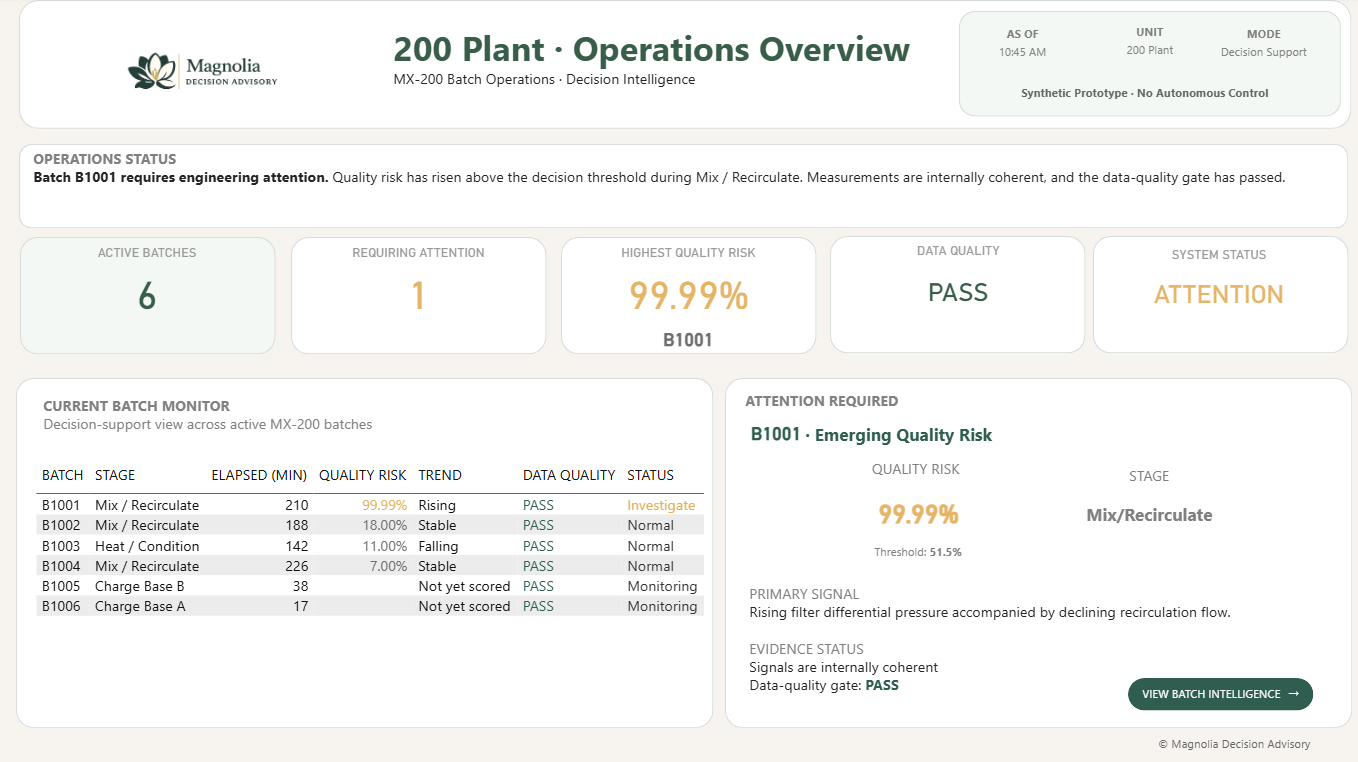
6 ACTIVE BATCHES
Plant-wide monitoring
1 REQUIRES ATTENTION
B1001 automatically surfaced
99.99% QUALITY RISK
Above the 51.5% decision threshold
WHY THIS MATTERS
The operator does not need to inspect every batch individually—the system narrows attention to the batch where the evidence warrants investigation.
05
Batch Intelligence
The process trajectory reveals an emerging deviation
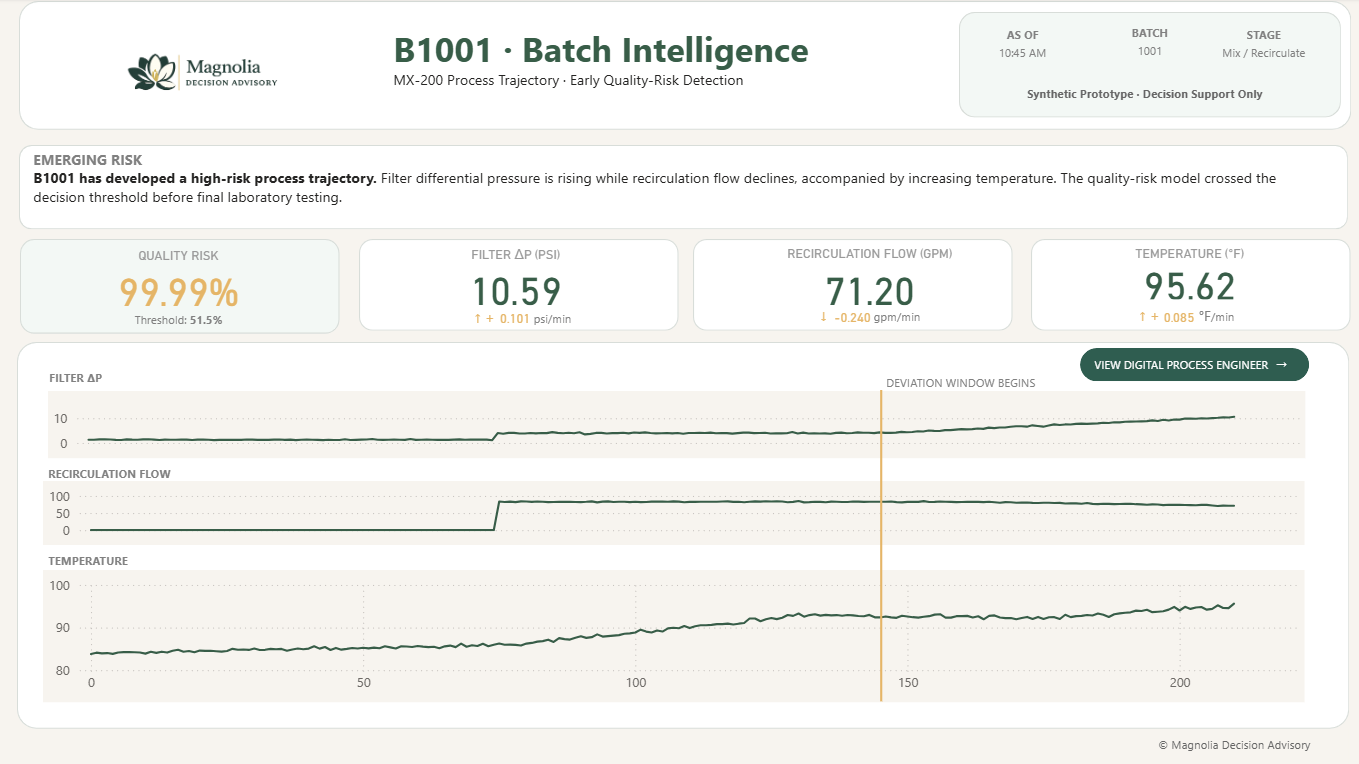
For B1001, filter differential pressure rises while recirculation flow declines and temperature trends upward. Together, these trajectories show that the warning reflects a developing process pattern rather than a single isolated measurement.
WHY THIS MATTERS
Early warning is most useful when the signal can be interpreted in process context—not merely displayed as a probability.
06
Diagnostic Assessment
A risk score alone is not enough
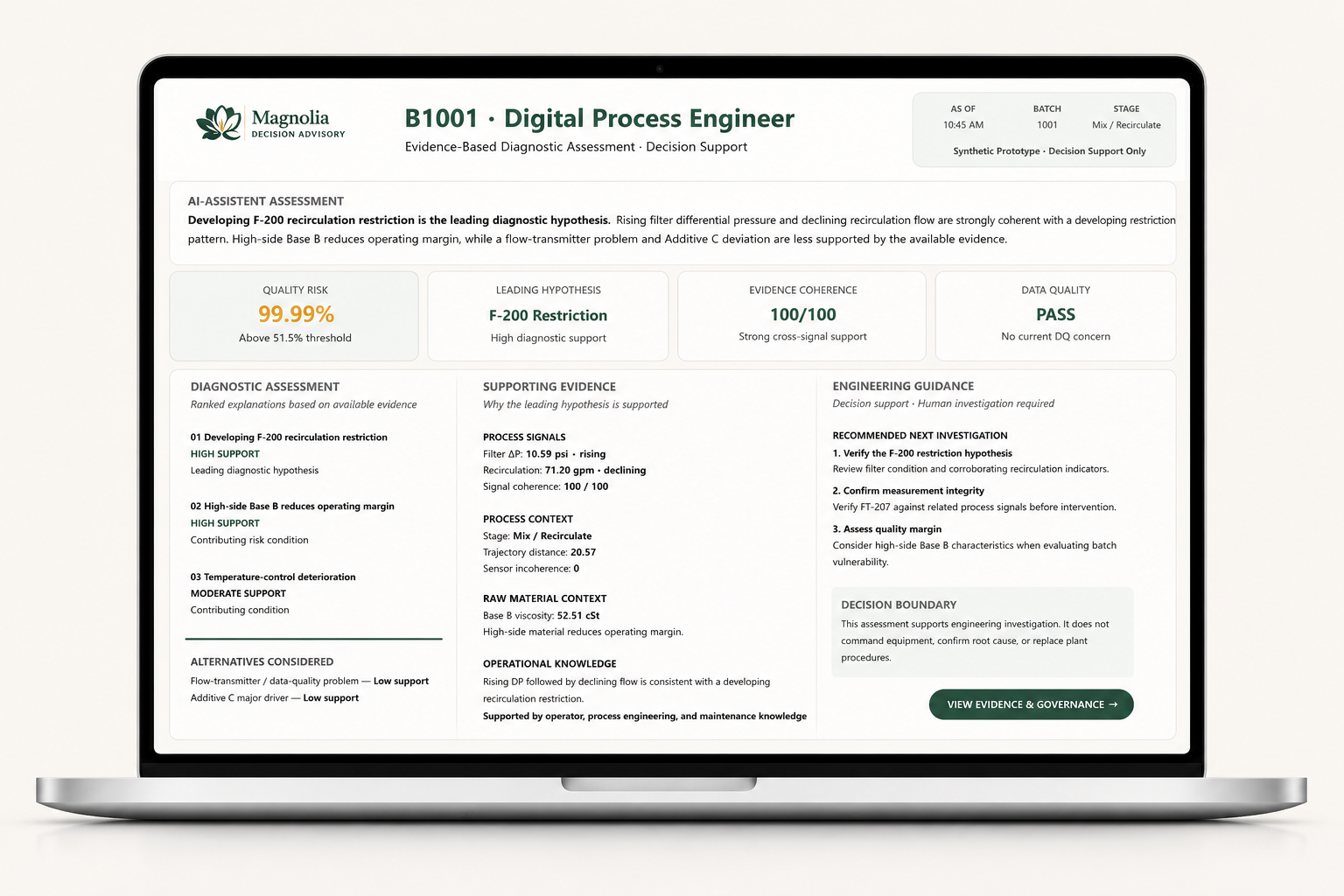
The Digital Process Engineer assembles a diagnostic assessment from coherent process signals, validated operational knowledge, process context, and historical evidence. It identifies a developing F-200 recirculation restriction as the leading hypothesis while keeping alternative explanations visible for investigation.
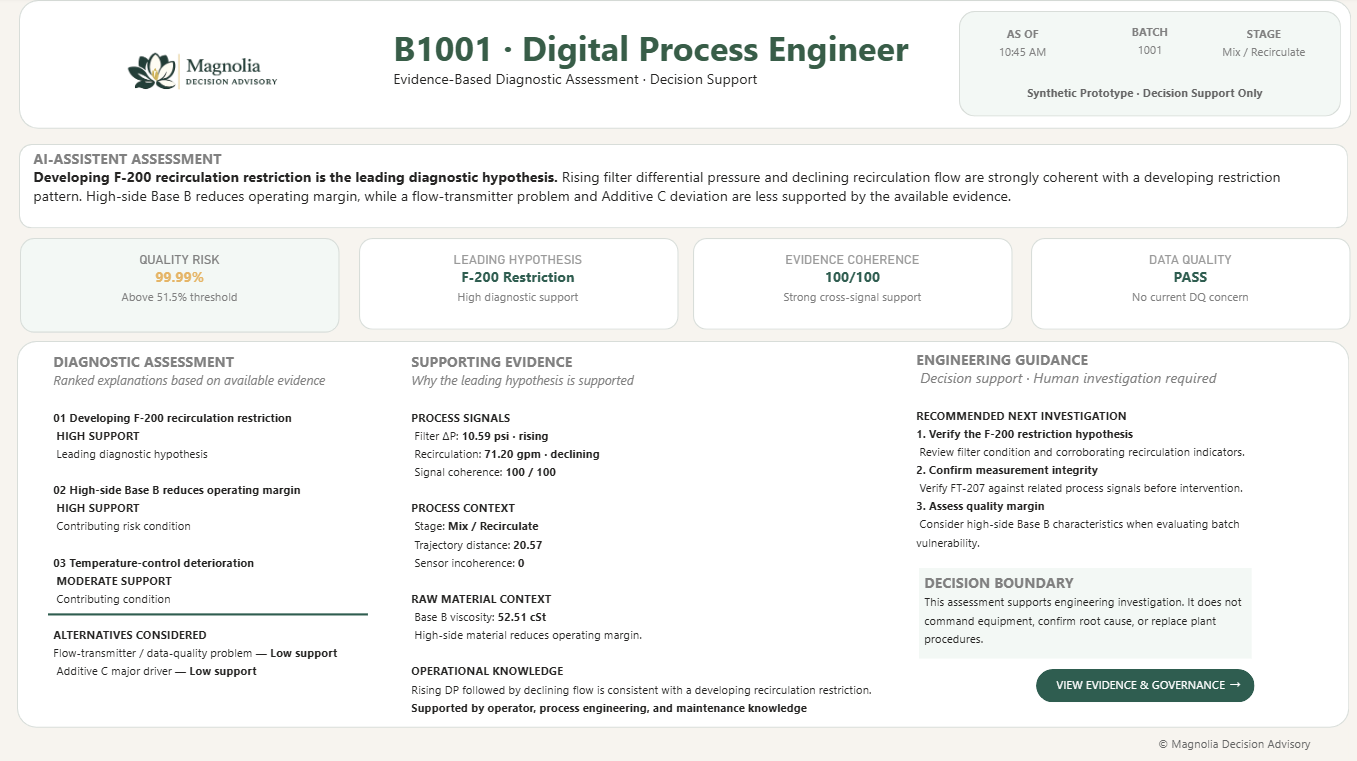
Leading hypothesis: F-200 restriction
Evidence coherence: 100/100
Data-quality gate: PASS
DECISION BOUNDARY
The recommendation is to investigate the F-200 restriction hypothesis, not to automatically intervene.
07
Evidence & Governance
What experienced people know can be structured, tested, and governed
Experienced operators and engineers often recognize patterns that are not fully captured in formal data models. The prototype converts those observations into structured Knowledge Cards and tests them against historical data where possible.
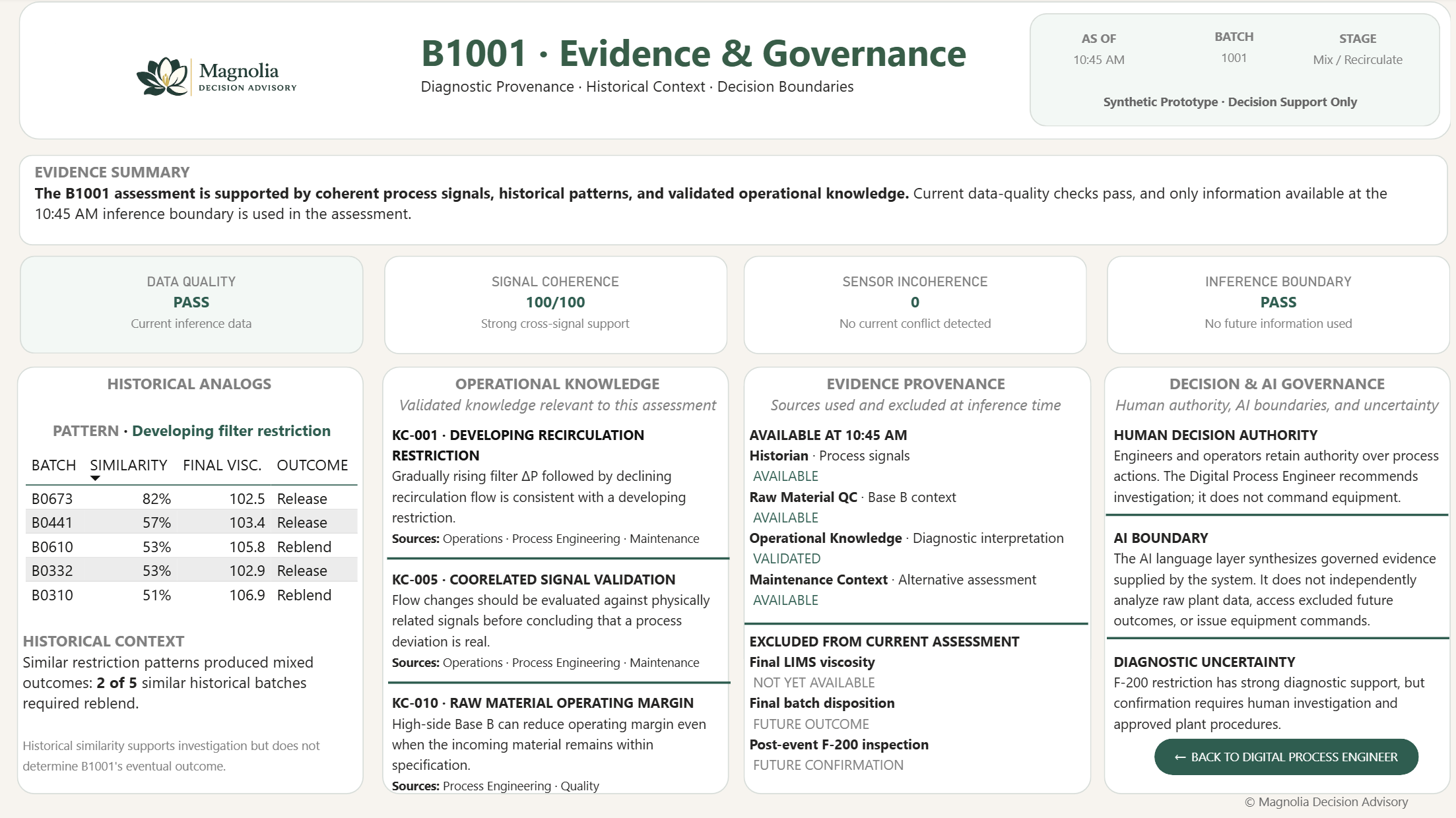
WHY THIS MATTERS
Historical similarity and expert knowledge inform the assessment without determining the outcome. Evidence provenance makes clear what the system knew—and what it did not know—at the moment of inference.
08
What the Prototype
Demonstrates
From prediction to governed decision support
The prototype demonstrates how predictive analytics, operational context, and AI-assisted reasoning can work together to support earlier, more explainable decisions—while preserving human authority over investigation and intervention.
DETECT EARLIER
Detect emerging risk before final outcomes are known
Process trajectories are evaluated during the batch, allowing elevated quality risk to surface before final laboratory testing.
EXPLAIN THE SIGNAL
Move beyond a probability score
Cross-signal patterns, process context, historical analogues, and operational knowledge help turn an alert into an interpretable diagnostic hypothesis.
STRUCTURE KNOWLEDGE
Bring operational expertise into a structured evidence base
Expert observations are captured as structured Knowledge Cards that can inform assessments and be evaluated against historical evidence.
GOVERN THE DECISION
Keep AI inside explicit decision boundaries
Process trajectories are evaluated during the batch, allowing elevated quality risk to surface before final laboratory testing.
DESIGN PRINCIPLE
The objective is not autonomous decision-making. It is to give the right person better evidence, earlier, with a clear understanding of what the system knows, what it does not know, and where human judgment begins.
09
How It
Was Built
Built as an end-to-end decision-support prototype
The prototype combines synthetic process data, predictive modeling, business rules, structured operational knowledge, and an interactive Power BI interface. Each layer serves a distinct purpose—from detecting emerging risk to translating evidence into governed engineering decision support.
01 — PROCESS DATA
Simulate the operating environment
Synthetic batch-level time-series data represent process measurements, operating conditions, and eventual quality outcomes.
Python · Synthetic Data
02 — PREDICTIVE ANALYTICS
Detect emerging quality risk
Time-series features and predictive models identify developing risk before final quality outcomes are available.
Python · Machine Learning
03 — EVIDENCE LAYER
Add context around the signal
Historical analogues, data-quality checks, process context, and operational knowledge provide evidence for interpreting model output.
Analytics · Knowledge Cards
04 — AI REASONING
Translate evidence into an assessment
AI-assisted reasoning synthesizes governed evidence into diagnostic hypotheses, alternatives, and areas for investigation.
Generative AI · Governed Context
05 — DECISION INTERFACE
Put the evidence in front of the user
Power BI connects monitoring, early warning, diagnostic assessment, provenance, and governance in one workflow.
Power BI · DAX
UNDER THE HOOD
ANALYTICAL PIPELINE
Python
Synthetic process simulation
Time-series feature engineering
Predictive risk modeling
Historical-analogue analysis
Model evaluation
DECISION-INTELLIGENCE LAYER
Cross-signal evidence coherence
Data-quality gates
Operational Knowledge Cards
Evidence provenance
Inference boundaries
Alternative hypotheses
USER EXPERIENCE
Power BI
DAX measures
Cross-page navigation
Operational monitoring
Diagnostic assessment
Governance interface
DESIGN PRINCIPLE
The predictive model is one component of the system—not the product itself. The prototype was designed around the full path from process signals to evidence, interpretation, and human decision-making.
10
Closing Perspective
Decision intelligence is more than prediction
This prototype explores a broader question: How can analytics and AI help people make better decisions before the answer is known? The result is a decision-support system designed to detect emerging risk, assemble relevant evidence, make uncertainty visible, and preserve human authority over consequential decisions.
Predictive Analytics
Detect emerging patterns before outcomes are known.
Applied AI
Turn fragmented evidence into structured, explainable decision support.
Decision Intelligence
Connect models, operational context, and human judgment to support the decision at hand.
START A CONVERSATION
What decision is in front of you?
If your organization is facing an important investment, market, AI or strategic decision, let’s discuss it.