
Decision Infrastructure: The Missing Organizational Capability in the Age of AI
July 27, 2026 | Rebecca Osakwe | Founder, Magnolia Decision Advisory | 45 min read
Editor's note (October 13, 2026): This essay has been reviewed and lightly edited for clarity and consistency. An adapted three-part series, featuring simplified figures optimized for mobile reading, is also available in The Magnolia Brief.
As AI makes information increasingly abundant, competitive advantage will depend less on acquiring more information than on making better decisions. This essay presents a framework for understanding Decision Infrastructure as organizational capital that strengthens strategic judgment under uncertainty.
Key Takeaways
Organizations have invested heavily in AI and analytics but comparatively little in improving how strategic decisions are made.
Decision Infrastructure is the organizational capability that transforms abundant information into disciplined judgment.
As AI makes analysis increasingly accessible, competitive advantage will depend more on decision quality than information advantage.
Decision Infrastructure is a form of organizational capital that strengthens governance, resilience, and long-term strategic performance.
Organizations that intentionally build Decision Infrastructure will be better equipped to navigate uncertainty, adapt to change, and sustain competitive advantage.
I. The Paradox of the Information Age
Organizations have never had greater access to information than they do now. Executives can monitor global markets in real time, track operational performance from virtually anywhere, and draw on analytical tools that would have seemed extraordinary only a generation ago. Artificial intelligence is accelerating this transformation, enabling organizations to summarize technical reports, identify patterns across vast datasets, and generate sophisticated analyses within seconds. By almost every measure, the cost of obtaining information has declined while the quantity of available information has expanded dramatically.
For decades, this was precisely the future businesses were working toward. Advances in computing power, enterprise software, cloud infrastructure, and data analytics promised to reduce uncertainty by giving leaders access to more complete and timely information. Those investments have transformed how organizations understand their operations, customers, and markets.
Organizations invested an estimated $235 billion globally in artificial intelligence in 2024, and spending was projected to exceed $630 billion annually by 2028.¹ Yet an important paradox has emerged. Despite these unprecedented investments in AI, data, and analytics, many leadership teams continue to face increasingly difficult strategic decisions. This is not because organizations possess too much information, but because the nature of uncertainty itself has changed. Information has become increasingly abundant while the competitive, technological, geopolitical, and regulatory environments in which organizations operate have grown markedly more complex.
The challenge confronting modern leaders is therefore no longer defined primarily by limited access to information. Instead, it lies in interpreting an ever-growing volume of evidence whose significance is often uncertain. Strategic decisions are increasingly shaped by interacting forces—including market conditions, regulation, geopolitics, technological innovation, workforce dynamics, capital markets, and public expectations—that evolve simultaneously rather than independently. Executives often possess more evidence than ever before while feeling less certain about the conclusions they should draw from it.
Consider a company evaluating a major capital investment in the energy sector. Twenty years ago, the analysis might have centered largely on projected demand, expected commodity prices, financing costs, and operational feasibility. Those considerations remain essential, but they no longer capture the full scope of the decision. A comparable investment now depends on electricity availability, transmission constraints, workforce capacity, supply chain resilience, cybersecurity risks, environmental regulation, technological change, and geopolitical developments that can reshape market conditions with little warning. These factors do not operate independently; they interact in ways that traditional forecasting models were never designed to accommodate.
Artificial intelligence has understandably become central to discussions about how organizations should respond to this growing complexity. Its ability to automate routine analysis, identify patterns, and rapidly synthesize information offers tremendous promise. Whether future generations of artificial intelligence—including the possibility of artificial general intelligence (AGI)—may eventually assume a greater role in strategic judgment remains an open question. Regardless of how that debate unfolds, organizations face an immediate challenge: making sound strategic decisions in a world where human leaders remain accountable for their consequences. As argued later in this article, strengthening Decision Infrastructure prepares organizations for either future—whether AI remains primarily an analytical tool or evolves into a far more autonomous strategic partner.
The result is that many organizations have become exceptionally good at producing information while devoting comparatively less attention to the organizational capabilities required to transform that information into consistently sound decisions. As information continues to become more abundant, this imbalance is likely to become increasingly consequential.
Those organizational capabilities are rarely examined as a distinct strategic asset. Yet they shape how uncertainty is interpreted, how competing perspectives are reconciled, and how information ultimately becomes action. This article argues that these capabilities deserve to be understood as a form of Decision Infrastructure: the governance, processes, organizational culture, and leadership practices through which organizations consistently transform information into disciplined judgment.
II. An Overlooked Organizational Capability
When organizations struggle to make effective strategic decisions, the explanations are usually familiar. Leaders conclude that they need better data, more sophisticated analytics, stronger forecasting models, or additional subject-matter expertise. These investments often improve the quality of analysis, yet they do not explain why organizations with access to comparable information frequently arrive at very different strategic decisions.
The contrast became especially visible during the COVID-19 pandemic. Retailers, manufacturers, hospitals, and logistics companies all confronted extraordinary uncertainty while drawing on many of the same public health data, economic forecasts, and consumer spending indicators. Some rapidly reconfigured supply chains, accelerated digital investments, and adapted their operating models, while others delayed major decisions in search of greater certainty.² The difference was not simply access to better information, but how each organization interpreted uncertainty, challenged assumptions, weighed competing risks, and determined when sufficient evidence existed to act.
The same pattern has appeared repeatedly in the energy sector. Before the 2014 collapse in oil prices, many companies approved multibillion-dollar investments under the assumption that prices near $100 per barrel would persist. When prices fell, projects across the industry were delayed, restructured, or written down, resulting in billions of dollars in losses.³ Nearly every company had access to the same commodity prices, analyst reports, and macroeconomic forecasts. What differed was not the availability of information, but the assumptions organizations made about the future, the range of scenarios they considered plausible, and the extent to which uncertainty had been incorporated into their investment decisions.
The Boeing 737 MAX crisis illustrates the same principle in a very different context. Following two fatal accidents that led regulators around the world to ground the aircraft in 2019, investigations examined Boeing's engineering decisions, certification process, governance, and organizational culture.⁴ Technical expertise existed throughout the organization, and concerns regarding the aircraft's flight-control system had been raised before the accidents occurred. The central issue was therefore not whether information was available, but how that information moved through the organization, how competing priorities were balanced, and how critical evidence ultimately influenced executive decision-making.
These examples reveal a common pattern. Organizations with access to similar information often make profoundly different decisions because information alone does not determine action. Decisions emerge through an organizational process in which evidence is interpreted, assumptions are tested, competing viewpoints are debated, risks are weighed, and uncertainty is translated into strategic choices. That process extends beyond any single department or technology platform. It emerges from the interaction of governance, analytical practices, leadership norms, decision processes, organizational culture, and accumulated institutional experience.
Despite its importance, this organizational capability receives remarkably little attention compared with physical assets, digital technologies, or human capital. Companies routinely invest in factories, software platforms, cybersecurity, workforce development, and artificial intelligence because these investments are widely recognized as drivers of long-term performance. Far less attention is devoted to the organizational architecture that determines whether those investments consistently produce sound strategic decisions. In many organizations, decision processes evolve gradually through precedent, organizational habits, and leadership preferences rather than through deliberate design.
Existing management concepts describe important aspects of this capability, but none fully captures the integrated organizational system through which information becomes coordinated action. Analytics generates insight. Governance establishes authority and accountability. Organizational culture shapes behavior. Strategy provides direction. Each contributes to effective decision-making, yet none fully explains the integrated organizational system through which information becomes coordinated action.
In this essay, I refer to that system as Decision Infrastructure.
Decision Infrastructure is the organizational capability that transforms information into disciplined judgment and judgment into strategy. It encompasses the structures, governance, analytical practices, decision processes, and organizational norms that enable leadership teams to evaluate uncertainty, challenge assumptions, integrate diverse forms of evidence, and consistently translate information into effective action. Like any form of infrastructure, its value is often most apparent when it is absent. Organizations with strong Decision Infrastructure recognize emerging risks earlier, adapt more effectively to changing conditions, and make complex decisions with greater confidence. Those with weaker Decision Infrastructure often possess many of the same informational resources but struggle to convert them into coherent action.
Viewed as a system, Decision Infrastructure occupies the critical organizational space between information and action. Figure 1 presents Decision Infrastructure as the organizational system that transforms information into disciplined judgment, connecting external conditions, information, governance, judgment, strategic decisions, and organizational learning into a single framework.
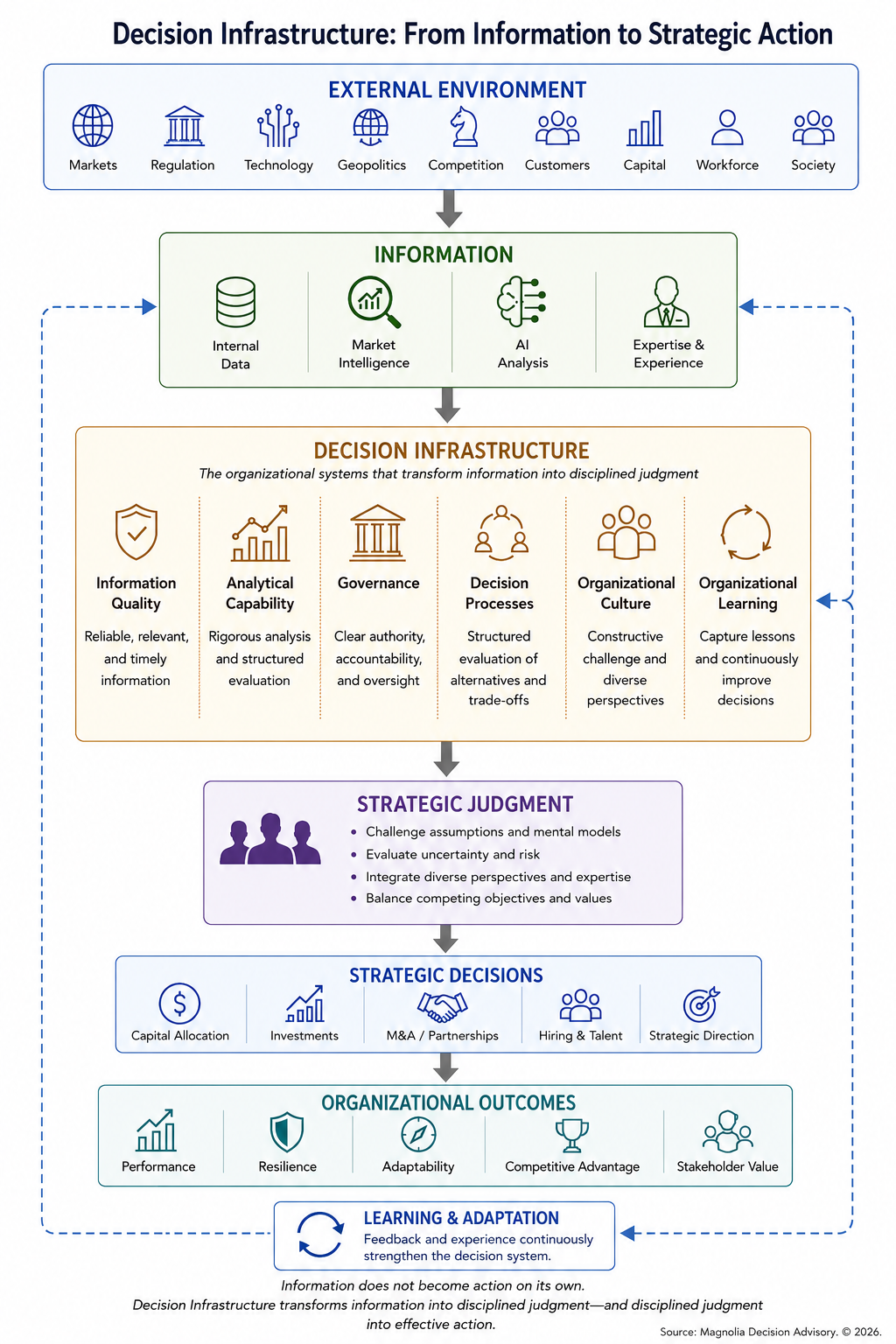
Figure 1. Decision Infrastructure: From Information to Strategic Action
III. From Forecasting to Structured Judgment
Consider an energy company evaluating a multibillion-dollar export facility expected to operate for thirty years or more. The decision depends on assumptions about commodity prices, global demand, construction costs, financing conditions, regulation, infrastructure capacity, and geopolitical risk. Executives commission engineering studies, market forecasts, financial models, environmental reviews, and assessments from external advisers. By the time the proposal reaches senior leadership, the organization possesses thousands of pages of analysis and multiple competing projections of the future.
The conventional approach is organized around a central forecast. Analysts estimate the most likely path for prices, demand, operating costs, and project revenues, and those assumptions are incorporated into a financial model. Leadership then evaluates whether the projected return exceeds the company's investment threshold. Sensitivity analyses may test how individual variables change, but the central forecast continues to anchor the discussion. The resulting decision can therefore appear more precise than the underlying conditions justify.
Forecasts are indispensable because organizations cannot allocate capital without forming expectations about the future. The problem arises when the forecast becomes the decision rather than one input into a broader decision process. Long-term investments are exposed to interacting uncertainties that cannot be resolved through greater analytical precision alone. Commodity prices may fall while financing costs rise, construction schedules lengthen, or demand expectations weaken. A decision process built around a single expected future can obscure the possibility that several assumptions may fail simultaneously.
Strong Decision Infrastructure changes the question being asked. Instead of asking whether the project is attractive under the most likely forecast, leadership asks whether the investment remains defensible across a range of plausible futures. Analysis shifts from identifying one "correct" prediction to identifying the assumptions that matter most, testing how the investment performs as those assumptions change, and determining where the organization retains room to adapt. The objective is not to eliminate uncertainty but to make it explicit before resources are committed. Figure 2 illustrates this shift from forecast-centered decision-making to a Decision Infrastructure model that emphasizes evaluating multiple plausible futures before selecting a resilient course of action.
A scenario-based decision tool helps structure this discussion. Rather than presenting one price projection, it allows leaders to compare the project under sustained high prices, prolonged weakness, and a more volatile environment in which markets repeatedly shift between the two. Each scenario incorporates different assumptions about demand, margins, costs, and timing while showing how financial and strategic performance changes. The value of the tool lies not in the sophistication of the dashboard itself, but in the quality of the conversation it enables.
Attention naturally shifts toward the project's underlying decision logic. Leadership can identify the assumptions required to justify the investment, the conditions under which returns deteriorate, and the variables with the greatest influence on the outcome. Executives can also distinguish between risks that must simply be accepted and those that can be reduced through contractual protections, phased investment, operational flexibility, or revised financing structures. The analysis becomes less about presenting possible outcomes than about testing the resilience of the strategy before substantial capital has been committed.
This process also exposes disagreements that might otherwise remain hidden. Finance may view the project primarily through expected return, while operating leaders focus on execution risk and commercial teams emphasize long-term market access. Government affairs professionals may assign greater weight to regulatory durability, and technical experts may be more concerned about infrastructure or construction constraints. These differences do not necessarily reflect conflicting facts. More often, they reflect different assumptions about which risks matter most and which outcomes the organization should prioritize.
Decision Infrastructure provides a disciplined way to bring those perspectives together. It clarifies who owns the decision, which evidence will be considered, how assumptions will be documented, and what conditions would justify changing course. It also creates a process through which dissenting views can be examined without allowing disagreement to delay action indefinitely. The objective is not universal agreement. It is a decision whose reasoning is explicit, whose assumptions can later be revisited, and whose consequences are understood by those responsible for implementation.
Many strategic failures cannot be traced to the absence of analysis. Organizations frequently possess detailed models, experienced employees, and capable advisers before making decisions that later prove costly. The weakness lies in the connection between those resources and the final choice. Information may remain fragmented across departments, assumptions may go unchallenged, and executive discussion may become anchored to a preferred outcome. A technically sophisticated model cannot compensate for a poorly designed decision process.
Good Decision Infrastructure therefore produces more than a decision. It produces a record of how the decision was reached, including the evidence considered, the uncertainties acknowledged, the alternatives rejected, and the conditions under which the decision should be reconsidered. That record enables organizations to learn as circumstances change rather than merely defend earlier choices. It also helps leaders distinguish between a poor decision and a poor outcome, recognizing that even disciplined decisions may be followed by events that could not reasonably have been predicted.
The purpose of scenario analysis is not to make leaders less willing to act. It is to help them act with greater clarity because they understand both the strength and the limits of the case before them. Rather than seeking certainty, Decision Infrastructure enables organizations to make disciplined decisions despite uncertainty.
IV. The Components of Decision Infrastructure
Like physical infrastructure, Decision Infrastructure is rarely visible during routine operations. Organizations do not discuss it in annual reports, measure it directly on financial statements, or assign responsibility for it to a single department. Yet it shapes virtually every significant strategic decision. Its strength is revealed not by any individual choice, but by the consistency with which organizations make sound decisions over time.
Decision Infrastructure should therefore be understood not as a single process or technology, but as an integrated organizational system. It emerges through the interaction of information quality, analytical capability, governance, organizational culture, decision processes, and organizational learning. No individual component is sufficient on its own. Sophisticated analytics cannot compensate for weak governance, just as experienced leadership cannot overcome fragmented information or poorly designed decision processes. Its effectiveness depends on how these elements reinforce one another. As shown in Figure 1, Decision Infrastructure consists of six mutually reinforcing organizational capabilities.
Information Quality
Every strategic decision begins with an understanding of the organization's operating environment. Information must be accurate, timely, relevant, and sufficiently complete to support meaningful analysis. Weak data quality, inconsistent definitions, delayed reporting, or fragmented information systems introduce unnecessary uncertainty before strategic judgment even begins. Reliable information does not guarantee sound decisions, but it establishes the foundation upon which they depend.
Analytical Capability
Analytical capability enables organizations to identify patterns, model scenarios, evaluate tradeoffs, and estimate the implications of alternative courses of action. Artificial intelligence has expanded these capabilities dramatically, making sophisticated analysis faster and more accessible than ever before. Yet analytical tools support judgment rather than replace it. Their value depends not only on the quality of their outputs, but on how effectively those outputs are incorporated into executive decision-making.
Governance
Governance determines who participates in major decisions, how authority is distributed, how disagreements are resolved, and which evidence is considered before commitments are made. Effective governance extends beyond organizational hierarchy. It creates decision rights while ensuring that important assumptions can be challenged and emerging risks receive appropriate attention before significant choices become irreversible.
Organizational Culture
Organizational culture determines whether individuals feel comfortable raising concerns, questioning prevailing assumptions, or presenting evidence that contradicts executive expectations. Where dissent is discouraged or uncertainty is interpreted as weakness, important information often fails to reach decision-makers until options have narrowed considerably. Cultures that encourage disciplined debate while maintaining accountability generally produce more resilient strategic decisions.
Decision Processes
High-performing organizations rarely rely on intuition alone when evaluating consequential choices. They establish repeatable methods for defining the decision, identifying assumptions, evaluating alternatives, documenting reasoning, and revisiting decisions as new information becomes available. These processes reduce cognitive bias, improve transparency, and create consistency across leadership transitions.
Organizational Learning
Every significant decision generates information regardless of its outcome. Organizations with mature Decision Infrastructure distinguish between poor decisions and unfavorable outcomes, recognizing that even well-reasoned decisions may produce disappointing results when external conditions change unexpectedly. Rather than evaluating success solely through outcomes, they examine whether assumptions proved accurate, whether evidence was interpreted appropriately, and how future decisions can be improved. Over time, this continuous feedback strengthens institutional judgment.
These components should not be viewed as independent capabilities. Weakness in one area frequently undermines strengths elsewhere. Exceptional analytics cannot compensate for a culture that discourages dissent. Strong governance cannot overcome unreliable information. The quality of organizational decisions depends not on excellence within any individual component, but on the coherence of the system as a whole.
Viewed in this way, Decision Infrastructure becomes a form of organizational capital. Like physical infrastructure, it requires deliberate investment, thoughtful design, and continual refinement. Unlike physical assets, however, its value is measured not by what it produces directly, but by the quality of the decisions that shape every other investment an organization makes.
V. Artificial Intelligence and the Future of Decision Infrastructure
The rapid advancement of artificial intelligence has transformed the economics of organizational analysis. Tasks that once required teams of analysts, weeks of research, or extensive technical expertise can increasingly be completed within minutes.⁵ Large language models can summarize reports, generate strategic alternatives, identify patterns across vast collections of documents, draft executive briefings, and assist with increasingly sophisticated quantitative analysis. As these capabilities continue to improve, producing information and analysis will become faster, less expensive, and more widely accessible than at any previous point in history.⁶
This transformation is often described as an information revolution. While accurate, that description understates its strategic significance. Artificial intelligence is changing where organizations create value. As sophisticated analysis becomes broadly accessible, competitive advantage shifts away from producing information and toward governing how information is interpreted, integrated with organizational knowledge, and translated into effective action.
For much of modern business history, organizations competed by developing superior access to information.⁷ Proprietary datasets, specialized analytical teams, forecasting models, and industry expertise created meaningful advantages because they were difficult to replicate. Artificial intelligence is steadily reducing those barriers. The strategic question therefore changes from Who can generate better analysis? to Who can consistently make better decisions with the analysis available?
Much of today's discussion surrounding artificial intelligence focuses on a single question: How capable will future AI systems become? Some researchers anticipate that increasingly advanced AI—or eventually artificial general intelligence (AGI)—may assume responsibilities that today remain uniquely human, including helping determine which organizational objectives deserve priority, how competing risks should be weighed, or when imperfect information is sufficient to justify action. Others remain more skeptical. Regardless of where one falls within that debate, organizations must make consequential decisions today while preparing for an uncertain technological future.
Decision Infrastructure is valuable precisely because it does not depend upon any single prediction about that future. Instead, it represents an organizational capability that remains valuable across multiple plausible paths for artificial intelligence.
Future 1: AI as an Analytical Partner
If artificial intelligence continues to develop primarily as an increasingly sophisticated analytical partner, organizations will rely on AI to generate analyses, model scenarios, identify patterns, and synthesize information at unprecedented speed. Human judgment, however, will remain responsible for interpreting those outputs, balancing competing objectives, and deciding when sufficient evidence exists to act.
In this future, organizations differentiate themselves less through analytical capability than through the quality of the decision processes that surround it. As analysis becomes abundant, disciplined judgment becomes the principal source of competitive advantage.
Future 2: AI as a Strategic Decision-Maker
A second possibility is that future AI systems become capable of exercising forms of strategic judgment that today remain primarily human. Even under this scenario, Decision Infrastructure becomes no less important. Its role simply evolves.
Organizations would still require governance systems that determine where AI authority begins and ends, which decisions may be delegated, when human oversight remains essential, how recommendations are evaluated, how accountability is assigned, and how organizational values, regulatory obligations, and stakeholder interests are incorporated into strategic choices. These are not merely technical questions. They are questions of organizational design.
Rather than replacing Decision Infrastructure, increasingly autonomous AI would operate within it.
Future 3: AI as an Organizational Dependency
A third possibility is that artificial intelligence becomes so deeply integrated into organizational operations that it evolves from an analytical tool into foundational infrastructure. Like electricity, the Internet, and cloud computing before it, AI may gradually become infrastructure upon which organizations come to depend. As organizations embed AI into forecasting, engineering, procurement, legal review, software development, executive briefing preparation, and strategic planning, the technology may become an operating assumption woven throughout the enterprise rather than simply another application.
In this future, the principal challenge is no longer whether AI produces accurate analyses or even whether it can exercise strategic judgment. It is whether organizations gradually lose the institutional capability to operate effectively without it. As dependence increases, resilience becomes as important as performance. Decision Infrastructure helps preserve the governance, institutional knowledge, and decision-making capabilities that enable organizations to remain effective—even when intelligent systems become indispensable.
Decision Infrastructure Across Uncertain Futures
Although these futures differ substantially, they lead to the same conclusion. Whether artificial intelligence remains primarily an analytical partner, evolves into an increasingly autonomous strategic decision-maker, or becomes infrastructure upon which organizations grow deeply dependent, organizations will still require the capacity to evaluate evidence, govern intelligent systems, preserve institutional judgment, and remain resilient as technology continues to evolve.
Decision Infrastructure provides the organizational framework within which those capabilities are developed. Rather than preparing organizations for one predicted future, it equips them to adapt across multiple plausible futures while preserving the institutional capacity for disciplined strategic judgment.
This perspective also reframes the role of leadership. Executives have traditionally derived influence from experience and privileged access to information. Those advantages remain valuable, but they are becoming less exclusive as analytical capabilities become increasingly democratized. Leadership therefore depends less upon possessing answers than upon designing organizations capable of making sound decisions—establishing effective governance, encouraging constructive challenge, integrating diverse perspectives, and guiding coordinated action despite incomplete information.
The organizations that benefit most from artificial intelligence are therefore unlikely to be those that merely deploy the most advanced technology. They will be those that combine technological capability with mature Decision Infrastructure. Artificial intelligence will continue to expand what organizations are capable of knowing. Decision Infrastructure will determine whether that knowledge becomes a durable source of sound judgment, organizational resilience, and sustained competitive advantage. The objective is not to reduce dependence on artificial intelligence, but to ensure that increasing dependence does not become organizational fragility.
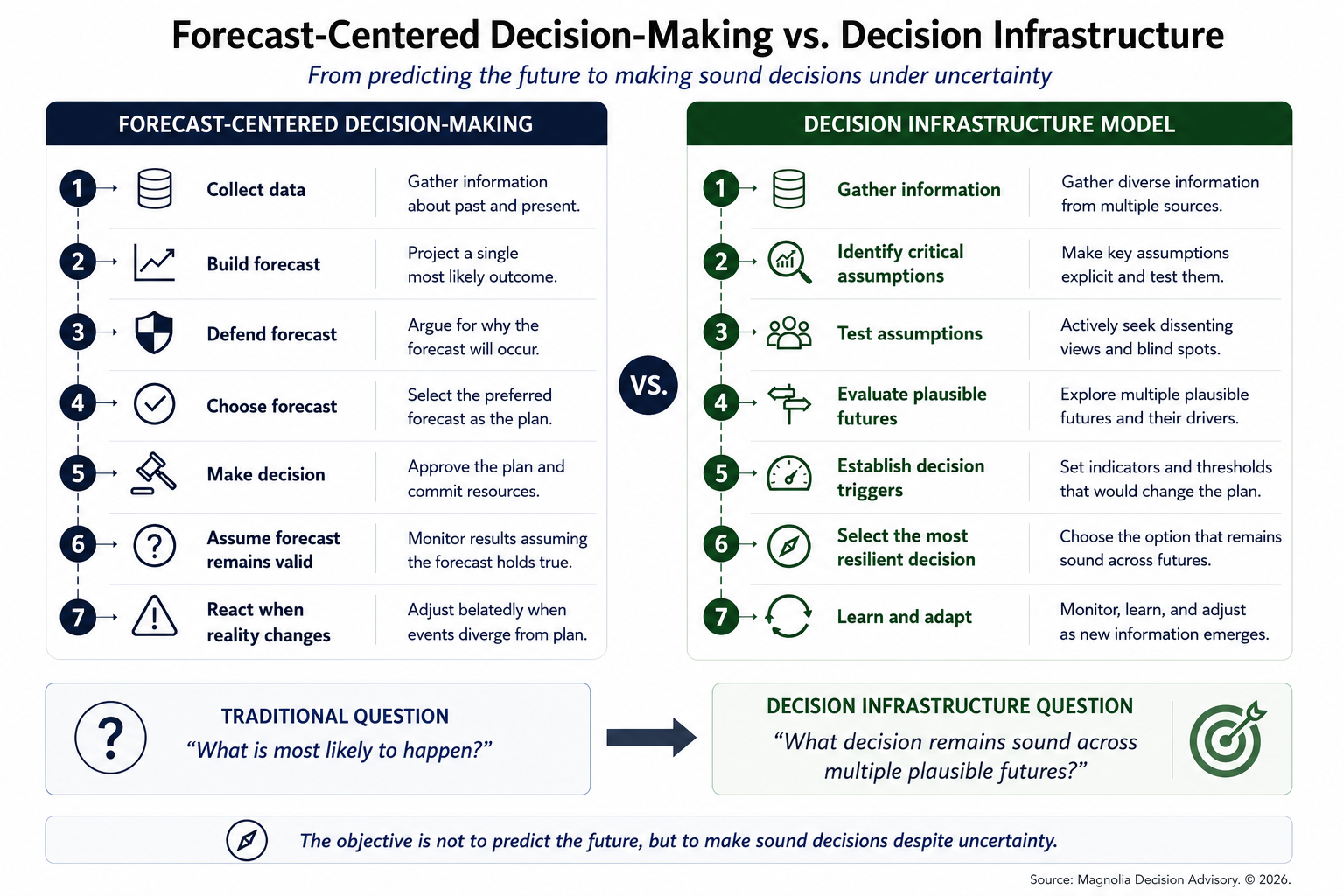
Figure 2. Forecast-Centered Decision-Making vs. Decision Infrastructure
VI. A Tale of Two Decisions
Case Illustration 1: Gulf Coast Energy Partners
Gulf Coast Energy Partners, a fictional energy company, is considering a $5 billion investment in a new liquefied natural gas export terminal. Market conditions appear favorable. Global LNG demand remains strong, oil prices have recovered following several years of volatility, and competing firms have announced similar projects. Internal financial models indicate that the investment comfortably exceeds the company's required rate of return.
Weeks before the board meeting, teams across the organization prepare extensive analyses. Economists update long-term commodity price forecasts. Engineers estimate construction costs and project schedules. Commercial teams assess customer demand and export opportunities. Finance develops discounted cash flow models and sensitivity analyses. By the time the executive committee convenes, hundreds of pages of reports have been distributed.
The meeting begins with a presentation from the chief financial officer, who explains that under the base-case assumptions the project generates an attractive internal rate of return and reaches profitability within the expected timeframe. Sensitivity analyses indicate that the investment remains financially viable under modest changes in commodity prices and construction costs. The discussion quickly centers on whether the base-case forecast is sufficiently realistic.
The chief economist expresses cautious optimism regarding long-term LNG demand but notes that increasing global supply could place downward pressure on prices later in the decade. The chief executive acknowledges the uncertainty but observes that every major investment involves assumptions about the future. Several board members remark that competitors are moving aggressively and caution against allowing excessive analysis to delay the opportunity.
As the meeting progresses, discussion increasingly centers on refining the central forecast. Executives debate whether WTI crude oil prices are likely to average $60 or $90 per barrel, whether construction inflation has peaked, and whether export demand projections should be revised. Each participant contributes valuable expertise, yet the discussion rarely moves beyond improving individual assumptions.
Several questions remain unexplored. No one asks which assumptions are most critical to the project's success or how multiple adverse events might interact if they occurred simultaneously. Construction delays, financing costs, geopolitical developments, and commodity prices are evaluated independently rather than as interconnected risks. Potential trigger points for revisiting the investment are never discussed because approval is implicitly treated as a final commitment.
Near the end of the meeting, a project manager briefly mentions that skilled labor shortages along the Gulf Coast are beginning to affect several large industrial projects. The observation receives little attention. Because the issue falls outside the financial presentation and cannot easily be incorporated into the existing model, discussion quickly returns to projected returns and competitive positioning.
After several hours, the executive committee recommends approval. The board endorses the investment, satisfied that management has conducted thorough analysis and that the financial case is compelling. Meeting minutes record the expected return, financing assumptions, and implementation timeline, but contain little discussion of the assumptions upon which the decision ultimately depends or the circumstances that might justify reconsidering the investment.
Three years later, the external environment has changed. Construction costs have risen sharply as labor shortages intensified, financing became more expensive, and LNG prices weakened simultaneously. None of these developments was entirely unexpected; each had been discussed individually during earlier planning. What surprised leadership was the cumulative effect of multiple adverse conditions occurring together. Executive meetings increasingly focused on explaining why forecasts proved inaccurate rather than evaluating whether the original decision process had adequately considered the range of plausible futures.
The organization did not fail because it lacked intelligence, technical expertise, or sophisticated analysis. It failed because its decision process was designed primarily to defend a forecast rather than test the resilience of the decision. The information was sound. The organizational process for converting that information into judgment was not.
The executives at Gulf Coast Energy Partners were experienced, well-informed, and acting in good faith. Their decision was not irrational. The weakness lay elsewhere. To understand the difference that Decision Infrastructure can make, consider the same investment evaluated by a second organization facing nearly identical market conditions.
Case Illustration 2: Delta Energy Holdings
Delta Energy Holdings, a fictional energy company, is evaluating the same proposed $5 billion investment in a liquefied natural gas export terminal. Like many firms in the industry, leadership recognizes the opportunity created by growing global demand while acknowledging the uncertainty surrounding commodity markets, construction costs, and long-term energy policy. Internal financial analysis indicates that the project is commercially attractive, and several competitors have recently announced similar investments.
As in many organizations, extensive analysis precedes the executive committee meeting. Economists prepare market outlooks, engineers develop construction estimates, commercial teams assess customer demand, and finance builds detailed valuation models. By the time senior leadership convenes, every executive has reviewed essentially the same types of information available to Gulf Coast Energy Partners.
The meeting begins differently.
Rather than asking whether the forecast justifies the investment, the chief executive opens with a broader question.
"Before we discuss the recommendation, what assumptions must prove true for this project to succeed?"
The chief economist identifies three assumptions that appear fundamental: sustained LNG demand in Asia, continued access to export markets, and commodity prices remaining within a range that supports long-term profitability. Rather than debating whether each assumption is likely to prove correct, the discussion shifts toward understanding their importance to the overall investment.
The chief operating officer raises a separate concern. Large industrial projects are already competing for skilled labor across the Gulf Coast, increasing the likelihood of construction delays and cost escalation. The chief financial officer asks how those risks interact with higher borrowing costs if interest rates remain elevated. The chief risk officer recommends evaluating scenarios in which multiple adverse conditions occur simultaneously rather than assessing each variable independently.
Rather than defending a single forecast, the executive team begins testing the resilience of the decision. They ask which uncertainties can be reduced through contractual arrangements, which risks should simply be accepted, and which assumptions require ongoing monitoring after approval. Attention shifts from predicting one future to preparing for several plausible futures.
Disagreement is treated as a source of information rather than an obstacle to consensus. Commercial leaders remain optimistic about demand growth while operations executives express greater concern about execution risk. Rather than forcing agreement, leadership documents competing assumptions and evaluates how each affects the investment under different scenarios. The objective is not unanimity but a fuller understanding of the decision before capital is committed.
The board ultimately approves the investment, but the approval includes explicit conditions. Management is instructed to secure fixed-price construction agreements where practical, establish predefined indicators that will trigger a formal review of project economics, and present quarterly updates evaluating whether the assumptions supporting the original decision remain valid. The board also requests a contingency plan outlining potential responses if multiple adverse conditions emerge simultaneously.
Three years later, construction costs rise, financing becomes more expensive, and LNG prices weaken. The developments are significant, but they are not entirely unexpected. Because leadership had previously identified these possibilities and agreed upon objective review criteria, discussion focuses less on explaining why forecasts changed and more on determining whether the investment continues to satisfy the conditions established before construction began. Some mitigation strategies are activated immediately, while others are revised in light of new information. The organization adapts without abandoning its underlying decision process.
Whether the investment ultimately succeeds remains uncertain. Success is important, but no single outcome can fully validate or invalidate the quality of the decision that produced it. Markets continue to evolve, and no amount of analysis can eliminate that uncertainty. What distinguishes Delta Energy Holdings is not superior forecasting or greater technical expertise. It is the deliberate design of a decision process that encourages competing perspectives, makes critical assumptions explicit, prepares for multiple plausible futures, and enables the organization to adapt as conditions change. Rather than treating uncertainty as an obstacle to be eliminated, the company incorporates it into strategic decision-making.
At first glance, the two organizations appear remarkably similar. Both employ experienced executives. Both invest heavily in market research. Both build sophisticated financial models. Both possess access to essentially the same information. Neither lacks intelligence, expertise, nor analytical capability.
Yet the conversations unfold very differently. Gulf Coast Energy Partners organizes its deliberations around defending a forecast. Delta Energy Holdings organizes its deliberations around testing the resilience of a decision. One leadership team seeks confidence in a prediction. The other seeks confidence that the organization can make a sound decision despite uncertainty.
The distinction lies not in the quantity of analysis available to each organization, but in the organizational process through which that analysis is interpreted, challenged, and ultimately translated into action.
Decision Infrastructure does not eliminate disagreement or guarantee successful outcomes. Markets remain uncertain, and even the most disciplined organizations cannot predict every future development. What Decision Infrastructure changes are the questions organizations ask before committing resources. Instead of asking only which forecast is most likely to prove correct, leadership asks which assumptions matter most, which uncertainties deserve the greatest attention, and under what conditions today's decision should be reconsidered.
The difference is not that organizations become right more often. It is that they become better at reasoning under uncertainty, learning from experience, and improving the quality of future decisions. Decision Infrastructure is not what enables organizations to be right every time. It is what enables them to become wiser over time.
VII. Decision Infrastructure as Organizational Capital
Organizations have long recognized that certain forms of organizational capital create enduring competitive advantage. Manufacturing infrastructure expands productive capacity. Digital infrastructure accelerates the flow of information. Research and development drives innovation. Brand reputation builds customer trust. These capabilities require sustained investment because their value extends far beyond any single project or product. They shape an organization's ability to compete over decades rather than quarters.
Decision Infrastructure deserves to be understood as another form of organizational capital. Although it produces no physical output and appears on no balance sheet, it influences nearly every consequential choice an organization makes. Capital investments, acquisitions, product launches, hiring strategies, market expansion, and technology adoption all depend upon the quality of organizational judgment. Over time, the cumulative effect of those decisions often proves more consequential than any individual investment.
Every major organizational investment ultimately depends upon a decision. Decision Infrastructure is therefore the organizational capability that influences the value created by every other strategic investment. Unlike manufacturing infrastructure, digital infrastructure, or research and development, its contribution is indirect but pervasive. It creates value not by producing a specific output, but by improving the quality of the decisions that determine how all other organizational resources are deployed. Figure 3 illustrates how the foundations of organizational performance have expanded from physical infrastructure to digital infrastructure and increasingly toward Decision Infrastructure as a capability for disciplined organizational judgment.
Like other forms of organizational capital, its value compounds over time. Well-designed decision processes improve individual decisions while strengthening the organization's capacity to learn from experience. Assumptions are documented, outcomes are evaluated, and reasoning becomes progressively more refined. Lessons acquired during one strategic decision inform the next, gradually embedding institutional knowledge within the organization rather than allowing it to remain dependent upon the experience or intuition of individual leaders.
This accumulated capability strengthens organizational resilience. Every organization will encounter economic disruption, technological change, regulatory shifts, geopolitical conflict, and unforeseen events. Organizations with mature Decision Infrastructure are not distinguished by an ability to predict these disruptions more accurately than others. They are distinguished by their ability to recognize emerging risks, reassess assumptions, coordinate responses, and adapt without abandoning coherent strategy.
Its importance becomes even more apparent as organizations grow. In smaller firms, founders often make consequential decisions personally, relying upon experience and close familiarity with daily operations. As organizations expand, decision-making becomes distributed across business units, functional specialties, geographic regions, and leadership teams. Information becomes fragmented, coordination becomes more difficult, and strategic alignment requires increasing discipline. Informal decision processes that once served the organization well gradually become insufficient. Sustained growth therefore depends not simply on capable leaders, but on organizational systems that enable sound decisions at scale.
The same principle applies to leadership succession. Organizations invest substantial effort in identifying and developing future executives, yet comparatively little attention is devoted to preserving the decision processes that supported previous success. When experienced leaders depart, institutional knowledge often departs with them. Strong Decision Infrastructure reduces this dependence by embedding effective reasoning within governance structures, decision processes, and organizational norms rather than relying exclusively upon individual expertise.
This perspective carries important implications for boards of directors and senior executives. Discussions of organizational capability have traditionally emphasized technology investments, talent acquisition, operational efficiency, and digital transformation. These priorities remain essential, but they invite an additional question:
How confident are we in the quality of the processes through which our most consequential decisions are made?
The answer cannot be inferred from financial performance alone. Favorable outcomes may reflect sound judgment, fortunate circumstances, or some combination of both. Assessing Decision Infrastructure requires examining the quality of reasoning, governance, constructive challenge, and organizational learning that precede action.
Organizations routinely audit financial controls, evaluate cybersecurity, assess operational resilience, and review compliance programs because these capabilities safeguard long-term performance. Decision Infrastructure deserves similar attention. Boards should understand how critical assumptions are challenged, how competing perspectives are incorporated, how uncertainty is evaluated, and how significant decisions are documented, revisited, and refined over time. These questions concern not operational efficiency but organizational effectiveness.
Decision Infrastructure should therefore be viewed not as an administrative process but as a form of organizational capital. Like any valuable form of capital, it requires intentional design, sustained investment, and continuous refinement. Organizations that cultivate this capability will not eliminate uncertainty or guarantee successful outcomes. They will, however, become progressively better at exercising disciplined judgment, adapting to change, and improving the quality of their decisions over time.
As analytical capabilities become increasingly accessible, competitive advantage will depend less upon possessing more information than upon using available information more effectively. Organizations that distinguish themselves will not necessarily be those that know the most. They will be those that have built the organizational capital to transform knowledge into disciplined judgment, disciplined judgment into effective action, and effective action into sustained competitive advantage.
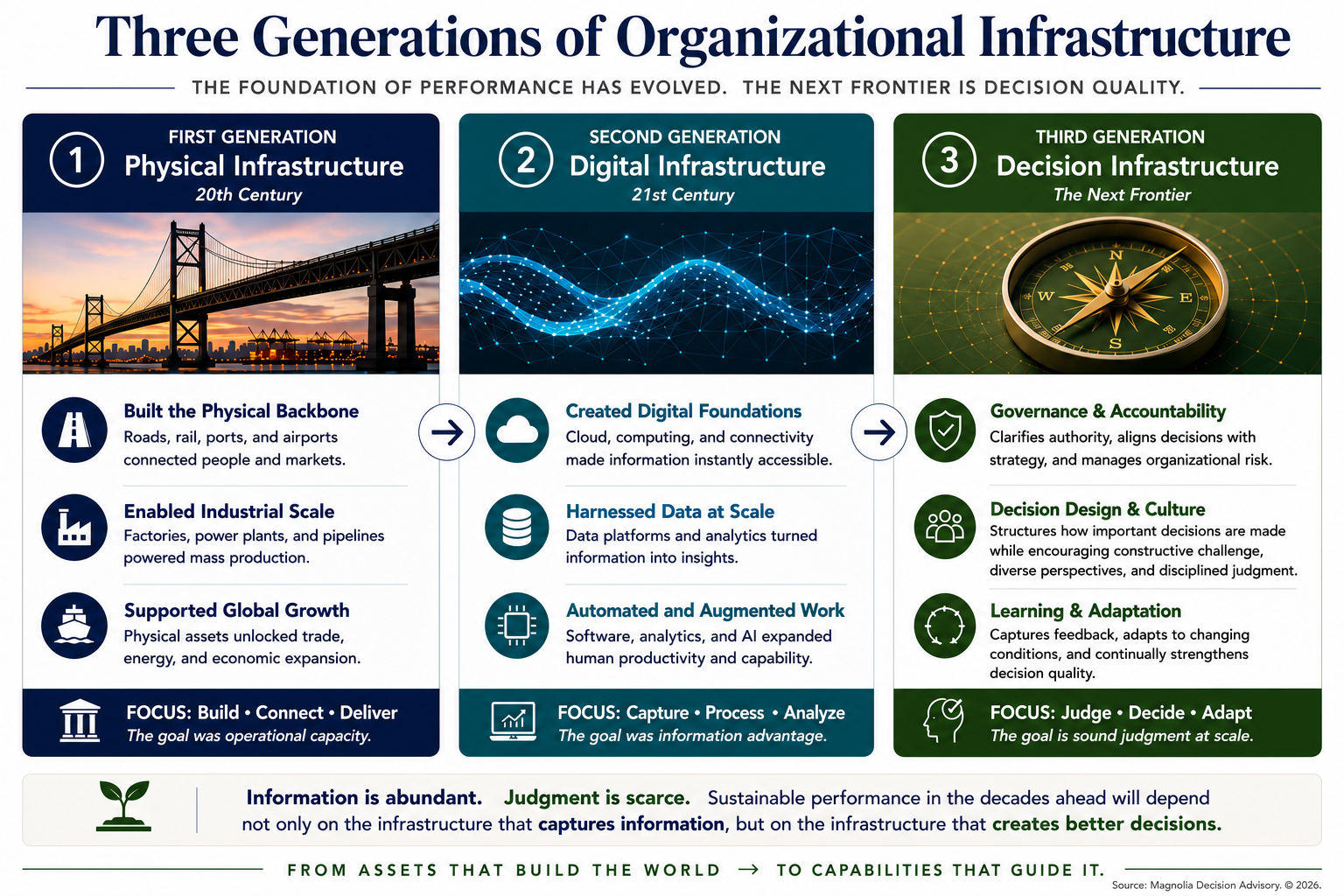
Figure 3. Three Generations of Organizational Infrastructure
VIII. Building Decision Infrastructure
Unlike a new technology platform or a major capital investment, Decision Infrastructure cannot be implemented through a single initiative. It develops gradually through the accumulation of governance practices, organizational norms, analytical capabilities, and leadership behaviors that shape how important decisions are made. In many organizations, these elements emerge organically over decades as processes evolve in response to crises, leadership transitions, acquisitions, regulatory change, and shifting strategic priorities. Some practices become institutionalized because they have repeatedly proven effective. Others persist simply because they have never been questioned.
This organic evolution presents an important challenge. Organizations devote considerable attention to improving what they do while giving comparatively little attention to how they decide. Budgeting, procurement, cybersecurity, compliance, and financial reporting are routinely documented, measured, and refined. The processes through which strategic decisions are made, however, often remain informal—embedded within executive meetings, organizational culture, and unwritten expectations rather than intentionally designed as an organizational capability.
Building Decision Infrastructure therefore begins not with adopting new technology or creating additional committees, but with examining the organization's existing decision processes. How are major strategic decisions currently made? Which assumptions receive the greatest scrutiny? Where do competing perspectives enter the discussion? Under what circumstances are decisions revisited as conditions change? These questions often reveal a striking imbalance: organizations possess sophisticated analytical capabilities without an equally sophisticated process for integrating those capabilities into executive judgment.
A defining characteristic of mature Decision Infrastructure is the ability to distinguish between improving decisions and improving outcomes. Sound decisions sometimes produce disappointing results because external conditions change unexpectedly, while poor decisions may occasionally be rewarded by favorable circumstances. Organizations that evaluate every decision solely by its eventual outcome risk reinforcing flawed reasoning while overlooking opportunities to improve the quality of judgment itself.
For this reason, mature organizations make their reasoning explicit. Significant decisions are accompanied by clearly articulated assumptions, documented alternatives, identified sources of uncertainty, and predefined indicators that will be monitored after implementation. Leadership also establishes the conditions under which the original decision should be reconsidered. These practices reduce hindsight bias, strengthen accountability, and transform major decisions into opportunities for organizational learning rather than isolated events whose underlying reasoning gradually disappears from institutional memory.
Building Decision Infrastructure also requires a culture in which constructive disagreement is viewed as an organizational asset rather than a threat. Many strategic failures occur not because warning signs were absent, but because they were discounted, fragmented across departments, or never communicated effectively to decision-makers. Organizations become more resilient when individuals are encouraged to challenge assumptions, present contradictory evidence, and articulate minority viewpoints before significant commitments are made. The objective is not consensus, but confidence that important decisions have been rigorously examined from multiple perspectives.
Artificial intelligence introduces an additional dimension to this evolution. As AI-generated analysis becomes increasingly integrated into executive workflows, organizations must determine not only how these tools will be used, but how they will be governed. Which decisions should rely heavily on AI-generated recommendations? Which require independent human review? How should model uncertainty be communicated to executives and boards? These are not primarily technological questions. They are questions of Decision Infrastructure.
Perhaps the most important principle is that Decision Infrastructure is never complete. Markets evolve, technologies mature, regulatory environments shift, and organizations themselves change over time. Processes that once supported effective decision-making may become less appropriate as complexity increases or strategic priorities evolve. Decision Infrastructure should therefore be viewed as a dynamic organizational capability requiring continual refinement rather than a system that can be designed once and left unchanged.
For leaders wondering where to begin, the objective is not to redesign every decision process at once. It is to begin asking better questions about the organization's existing decision system. A leadership team that regularly examines how assumptions are tested, how disagreement is incorporated, and how decisions are revisited over time has already taken an important step toward building stronger Decision Infrastructure.
Questions for Leadership Teams
How are our most consequential strategic decisions currently made?
Which assumptions are routinely challenged—and which are rarely questioned?
How are dissenting perspectives incorporated before major commitments are made?
Under what conditions do we formally revisit significant strategic decisions?
What mechanisms ensure that lessons from previous decisions improve future ones?
Building Decision Infrastructure is not a discrete management initiative but an ongoing organizational commitment. As technological change accelerates and strategic uncertainty becomes an increasingly permanent feature of the operating environment, organizations that distinguish themselves will not necessarily be those that collect the most information or deploy the most sophisticated analytical tools. They will be those that intentionally cultivate the organizational capability to transform abundant information into disciplined judgment—and disciplined judgment into consistently better decisions.
IX. Conclusion
Throughout modern business history, organizations have invested continuously in expanding what they know. They have built information systems, analytical capabilities, forecasting models, and, more recently, increasingly sophisticated artificial intelligence. Each generation of innovation has improved the speed, scale, and accessibility of information, fundamentally transforming how organizations operate. These investments will continue because information remains indispensable to effective decision-making.
Yet information has never been the ultimate objective. Organizations do not succeed because they possess more data than their competitors. They succeed because they make better decisions with the information available to them. As artificial intelligence reshapes the economics of knowledge work, analytical capability is becoming increasingly abundant while disciplined organizational judgment remains comparatively scarce. The central challenge is therefore shifting from producing more information to strengthening the organizational capability that transforms information into sound decisions.
This article has argued that this capability deserves to be understood as Decision Infrastructure: the governance, processes, organizational culture, and leadership practices through which organizations evaluate uncertainty, reconcile competing perspectives, exercise judgment, and translate analysis into coordinated action. Like physical infrastructure before it and digital infrastructure more recently, Decision Infrastructure is foundational. It does not determine what organizations know. It determines how effectively they use what they know.
The importance of this capability does not depend upon any single prediction about artificial intelligence. Regardless of how intelligent systems evolve, organizations will continue to confront decisions involving uncertainty, competing objectives, incomplete information, and accountability. Technology may transform how those decisions are informed, but it cannot eliminate the need for organizations to exercise judgment collectively and act coherently.
The implications extend well beyond the private sector. Governments allocate public resources under uncertainty. Universities establish long-term academic priorities. Hospitals make decisions affecting patient care and institutional investment. Nonprofit organizations confront increasingly complex social challenges while operating under significant resource constraints. In every case, the quality of outcomes ultimately depends not only on the information available, but on the organizational systems that transform information into disciplined judgment.
Every generation of organizations has been defined by the infrastructure in which it invested. The twentieth century was shaped by physical infrastructure. The early twenty-first century has been defined by digital infrastructure. The decades ahead will continue to require both. They will also require organizations capable of making sound decisions in an environment characterized by accelerating technological change, persistent uncertainty, and increasingly accessible analytical capability.
Artificial intelligence will continue to expand what organizations are capable of knowing. Decision Infrastructure will determine what organizations are capable of doing with that knowledge.
Ultimately, organizations do not compete solely on the quality of their products, technologies, or information. They compete on the quality of the decisions that shape all three. Decision Infrastructure should therefore be understood not simply as a management practice, but as a form of organizational capital—one that strengthens every other strategic investment an organization makes. In the decades ahead, the most enduring competitive advantage may not be superior information or even superior artificial intelligence. It may be the organizational capability to consistently transform knowledge into disciplined judgment, disciplined judgment into effective action, and effective action into long-term resilience.
REFERENCES
1. International Data Corporation (IDC). A Deep Dive Into IDC’s Global AI and Generative AI Spending. August 16, 2024. Source
2. McKinsey & Company. The COVID-19 Recovery Will Be Digital: A Plan for the First 90 Days. May 14, 2020. Source
3. Baffes, John, M. Ayhan Kose, Franziska Ohnsorge, and Marc Stocker. The Great Plunge in Oil Prices: Causes, Consequences, and Policy Responses. World Bank, Policy Research Note 1, March 2015. Source
4. U.S. House of Representatives, Committee on Transportation and Infrastructure. The Design, Development & Certification of the Boeing 737 MAX. September 2020. Source
5. Stanford Institute for Human-Centered Artificial Intelligence (HAI). AI Index Report 2025. Source
6. McKinsey & Company. The Economic Potential of Generative AI: The Next Productivity Frontier. June 14, 2023. Source
7. Porter, Michael E. Competitive Advantage: Creating and Sustaining Superior Performance. New York: Free Press, 1985. Source