
Beyond Investment: Turning Louisiana's Energy Boom into Long-Term Prosperity
June 18, 2026 | Rebecca Osakwe | Founder, Magnolia Decision Advisory | 8 min read
Louisiana is attracting unprecedented levels of energy investment. The opportunity is not simply to attract projects, but to convert today's capital into lasting economic value.
I. The Opportunity
Louisiana is in the midst of one of the largest energy investment cycles in its history. Since early 2024, Louisiana has attracted more than $100 billion in announced capital investments across LNG export facilities, natural gas infrastructure, industrial development, and emerging energy technologies.¹ Much of this activity is concentrated in the LNG sector, where several major projects are reshaping Louisiana's role in both the U.S. and global energy economy.
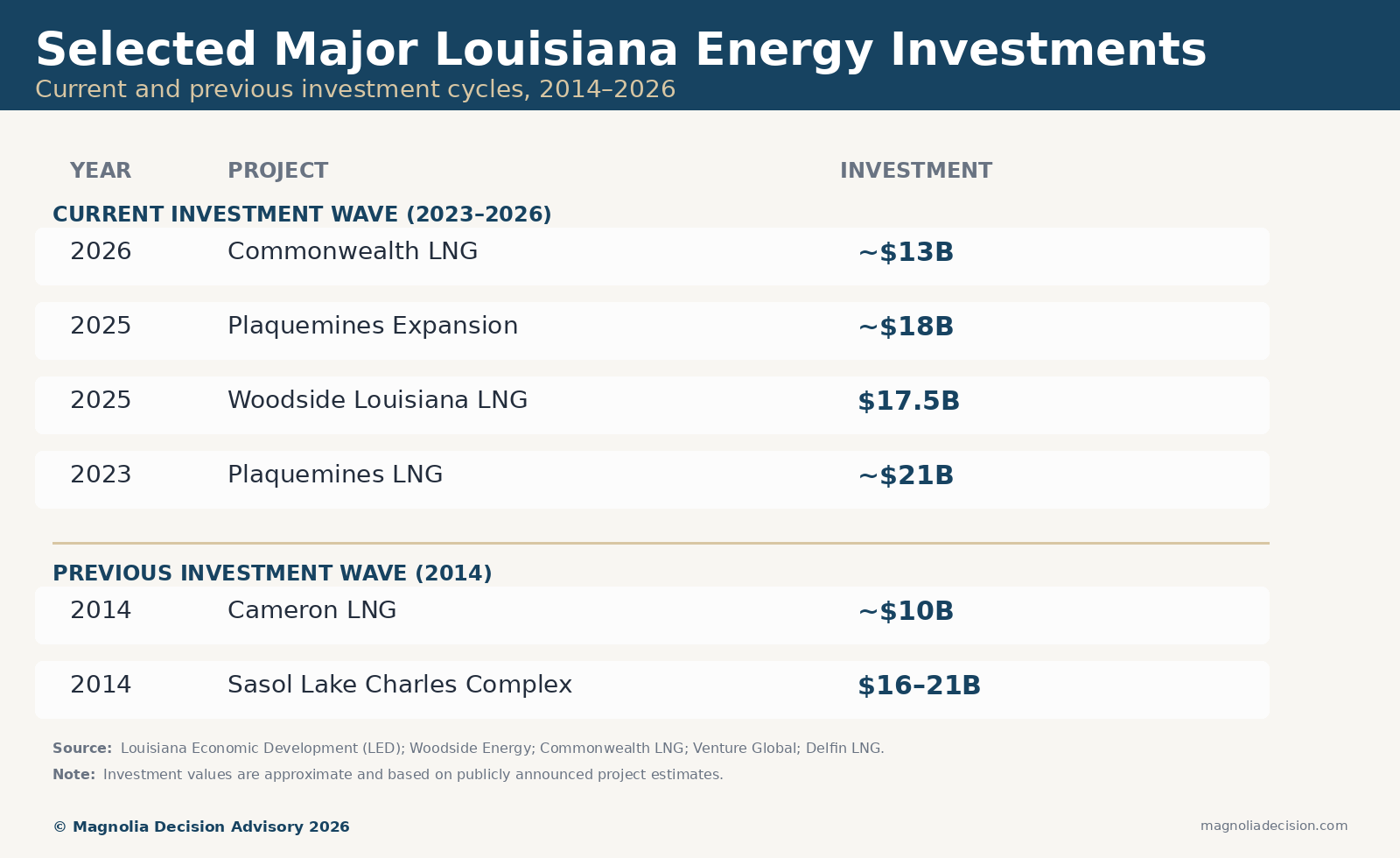
In 2025, Woodside Energy approved a $17.5 billion final investment decision for its Louisiana LNG project in Calcasieu Parish, making it the largest foreign direct investment project in Louisiana's history.² In May 2026, developers approved the $13 billion Commonwealth LNG export facility in Cameron Parish, which is expected to generate more than $3 billion in annual export revenue once operational.³ At the same time, Venture Global has proposed an approximately $18 billion expansion of its Plaquemines LNG facility⁴, while Delfin LNG recently reached a final investment decision for what is expected to become the first floating LNG export facility in the United States.⁵
The significance of these investments extends beyond their size. Together, they reinforce Louisiana's position at the center of a changing global energy system. As demand for LNG, reliable power, industrial infrastructure, and AI-related energy capacity continues to grow, the Gulf Coast is becoming an increasingly important hub for both energy production and energy-intensive industries. Recent geopolitical disruptions have further highlighted the strategic importance of reliable energy supplies, export infrastructure, and secure supply chains, increasing the value of regions capable of providing them.
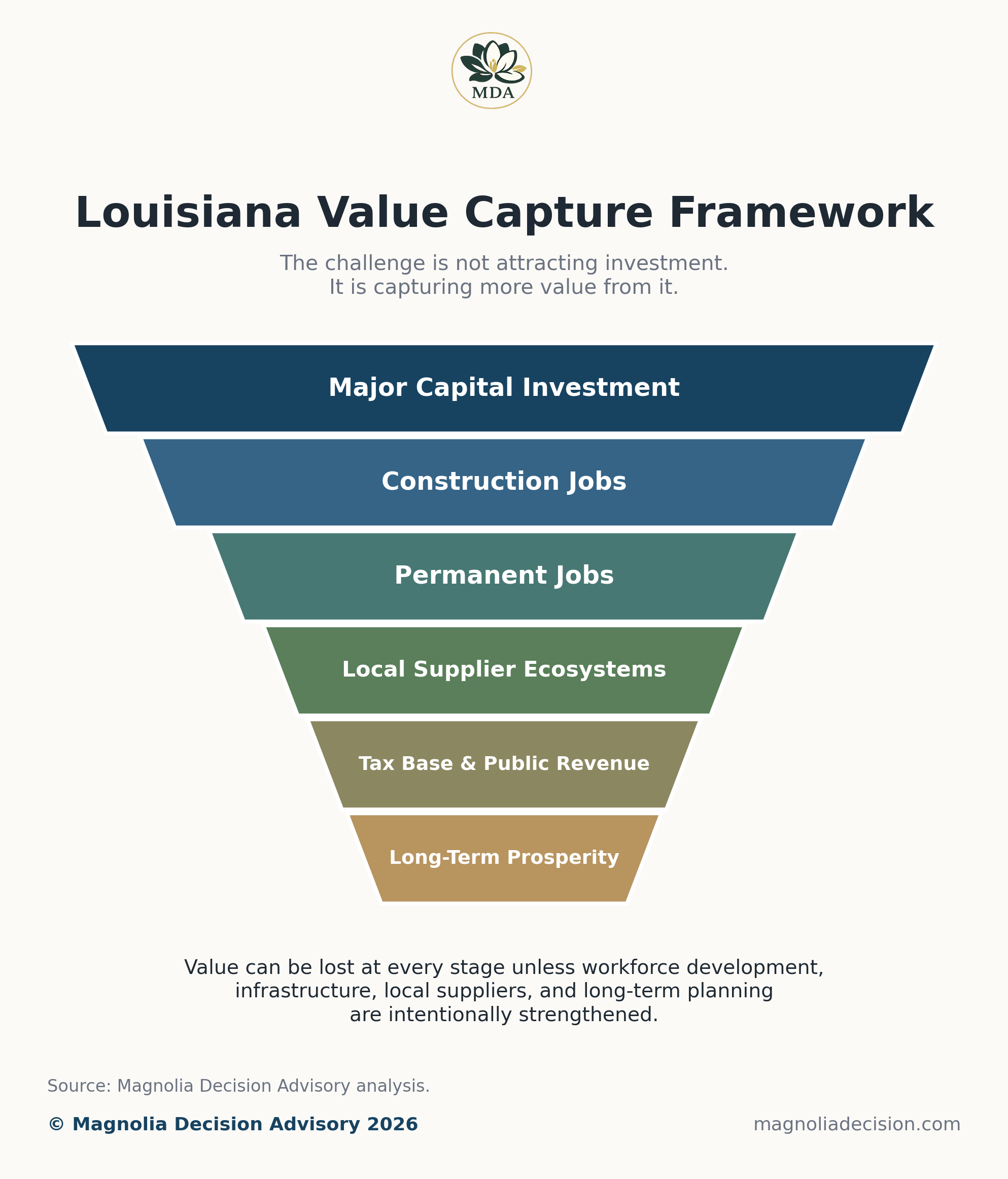
The opportunity for Louisiana is therefore larger than any single project or investment announcement. The challenge is to ensure that today's investments create lasting economic value that endures long after construction is complete.
II. The Risk
Louisiana has experienced major energy and industrial investment waves before. Following the shale revolution of the early 2010s, companies announced tens of billions of dollars in new petrochemical, manufacturing, and energy projects across the state. In 2014, economic development organizations described a "new energy boom" driven by approximately $21 billion in planned investments across Southeast Louisiana alone, accompanied by expectations of substantial job growth and economic transformation.⁶
Some of these projects were among the largest industrial investments in the state's history. Sasol's Lake Charles complex, for example, was initially projected as a $16–21 billion investment and promoted as one of the largest foreign direct investments in U.S. manufacturing history. The project was expected to create more than 1,200 permanent jobs and thousands of construction jobs.⁷ Louisiana also attracted major expansions from companies such as Shintech, along with numerous petrochemical, refining, pipeline, and export-related developments throughout the Mississippi River industrial corridor.
By many measures, Louisiana succeeded in attracting capital. The more difficult question is whether the state captured the full economic value of that investment. According to a recent analysis by The Data Center, Louisiana attracted more than $90 billion in energy and manufacturing investment over the last decade, yet statewide employment growth increased by just 0.18% between 2015 and 2025 while the state continued to experience population loss and lagged national economic growth trends.⁸
This does not mean those investments failed. They generated construction activity, tax revenues, export capacity, and high-paying jobs for many Louisianans. Industrial facilities remain important contributors to the state's economy. However, attracting projects and capturing their full economic potential are not necessarily the same thing.
The greatest value from major investments often comes not only from the facilities themselves, but from the broader ecosystems they help create. Local suppliers, technology companies, engineering firms, workforce development programs, research partnerships, entrepreneurs, and innovators all contribute to economic activity that extends far beyond a project's construction phase. These secondary and tertiary effects can continue generating value long after facilities become operational.
As Louisiana enters another investment cycle—this time driven by LNG exports, power infrastructure, industrial reshoring, and AI-related growth—the challenge is not merely to attract projects. It is to maximize the long-term value those projects create.
III. Five Areas to Prioritize
If Louisiana wants to capture more of the value created by today's energy investments, the focus cannot stop at attracting projects. The next challenge is building the capabilities that allow more of the economic benefits to remain within the state.
1. Workforce Development
Large industrial projects require engineers, electricians, welders, operators, project managers, data professionals, and skilled technicians. While construction jobs are important, the greatest long-term value comes from developing a workforce that can support operations, maintenance, innovation, and future industries.
Louisiana has an opportunity to strengthen partnerships among industry, universities, community colleges, and workforce development organizations to ensure that local residents are prepared for the jobs being created. Success should be measured not only by the number of jobs announced, but by the percentage of those jobs filled by Louisianans.
2. Infrastructure
Energy infrastructure has always been one of Louisiana's competitive advantages. The state's ports, pipelines, waterways, rail networks, and industrial corridors helped make it a global energy hub.
The next investment cycle will require expanding that foundation. Reliable electric power, transmission capacity, transportation networks, broadband connectivity, flood protection, and resilient infrastructure will all influence where future investments occur.
The regions that attract the most investment are often those that reduce friction for businesses. Infrastructure is what makes growth possible at scale.
3. AI and Data Centers
Artificial intelligence is creating a new source of energy demand.
As companies invest in data centers and advanced computing infrastructure, access to reliable and affordable electricity is becoming a strategic advantage. Louisiana's position as a major energy producer, combined with its existing industrial infrastructure, could create opportunities to attract energy-intensive industries that require large amounts of power.
If Louisiana can pair abundant energy resources with reliable electric infrastructure, the state may be well positioned to compete for a share of the growing data center and AI infrastructure market. Access to dependable power may become one of the defining competitive advantages for regions seeking to attract data centers, advanced manufacturing facilities, and other energy-intensive industries.
The opportunity extends beyond data centers themselves. AI is increasingly being deployed across energy production, logistics, manufacturing, supply chains, and industrial operations, creating new opportunities for productivity and innovation. Regions that successfully connect energy infrastructure with digital infrastructure may be particularly well positioned for long-term growth.
Historically, Louisiana's competitive advantages have included access to energy, transportation infrastructure, and industrial land. The rise of AI presents an opportunity to leverage those strengths in new ways while positioning the state for the next generation of industrial development.
4. Local Supplier Ecosystems
The economic impact of major projects extends far beyond the facility itself.
Engineering firms, equipment suppliers, software providers, construction companies, logistics operators, maintenance contractors, and professional service firms all play a role in supporting large-scale investments.
The more of those services that can be provided by Louisiana-based businesses, the more economic value remains within the state. Strong local supplier networks can create opportunities for entrepreneurs, small businesses, and mid-sized firms while making the broader economy more resilient.
A successful LNG project can support dozens of interconnected business ecosystems—from engineering and fabrication to logistics, software, workforce development, and professional services. The stronger those ecosystems become, the more value Louisiana can retain from future investment cycles.
5. Decision Intelligence and Long-Term Planning
The scale and complexity of today's investments require more than capital and infrastructure. They require effective decision-making.
Energy markets are increasingly shaped by geopolitical uncertainty, technological change, evolving regulations, and shifting demand patterns. Decisions made today will influence Louisiana's economic trajectory for decades.
The states and regions that benefit most from major investment cycles are often those that develop the capacity to anticipate change, evaluate tradeoffs, and make informed decisions under uncertainty.
This creates an opportunity for greater coordination among industry leaders, policymakers, educators, researchers, and economic development organizations. Better data, stronger forecasting capabilities, scenario planning, and long-term strategic thinking can help Louisiana identify opportunities, manage risks, and make more informed investments.
The goal is not to predict the future perfectly. It is to build the capacity to make sound decisions under uncertainty and adapt as conditions change.
IV. Conclusion
Louisiana stands at an important moment. The state is attracting billions of dollars in investment across LNG, industrial development, power infrastructure, and emerging technologies. Few regions are better positioned to benefit from the growing demand for energy, industrial capacity, and the infrastructure that supports them.
Whether this period is remembered as another investment cycle or as a turning point in Louisiana's economic development will depend on what happens next. Capital can build facilities, but lasting prosperity depends on the choices that surround those investments: how talent is developed, how infrastructure is prioritized, how local businesses participate, and how effectively leaders prepare for future opportunities and risks.
The investments being announced today will shape the state's trajectory for decades. Their ultimate impact will not be determined solely by export volumes, project counts, or construction spending, but by the extent to which they strengthen Louisiana's long-term economic capacity.
A decade from now, the most meaningful measure of success will not be how much money was invested, but what was built because of it: a more skilled workforce, stronger local businesses, greater economic resilience, and new opportunities for future generations.
Louisiana has an opportunity not only to host major projects, but to build the foundation for sustained growth long after those projects are complete.
REFERENCES
¹ Louisiana Economic Development (LED). Project announcements and capital investment reports, 2024–2026.
https://www.opportunitylouisiana.gov
² Woodside Energy. Louisiana LNG Final Investment Decision announcement (2025).
https://www.woodside.com
³ Commonwealth LNG. Final Investment Decision announcement and project materials (2026).
https://www.commonwealthlng.com
⁴ Venture Global. Plaquemines LNG expansion materials.
https://www.venturegloballng.com
⁵ Delfin LNG. Project announcements and Final Investment Decision materials.
https://www.delfinmidstream.com
⁶ Hobor, George and Elaine Ortiz. The Transformative Possibility of the New Energy Boom in Southeast Louisiana. The Data Center, January 2014.
https://gnocdc.s3.amazonaws.com/reports/GNOCDC_NewEnergyBoominSoutheastLouisiana.pdf
⁷ Louisiana Economic Development. "Sasol's Louisiana Project Wins Foreign Direct Investment Deal of the Year."
https://www.opportunitylouisiana.gov/news/sasol-s-louisiana-project-wins-foreign-direct-investment-deal-of-the-year
⁸ The Data Center. Pathways to Prosperity: Louisiana 2026.
https://www.datacenterresearch.org/reports_analysis/pathways-to-prosperity-louisiana-2026/