

About Magnolia Decision Advisory
Decision intelligence for complex energy environments
Magnolia Decision Advisory
Magnolia Decision Advisory is a boutique advisory firm that helps energy leaders make better strategic decisions by integrating economics, analytics, market intelligence, and AI.
Energy organizations operate in environments shaped by market volatility, capital-intensive investments, infrastructure complexity, and rapidly evolving technologies. While analytical capabilities have expanded, turning information into confident executive decisions remains a persistent challenge.
The firm's approach bridges that gap by transforming data, AI, and economic insight into structured guidance that leaders can confidently act upon.
Why Magnolia
The firm takes its name from the magnolia tree—a symbol deeply rooted in the Gulf Coast and the culture of New Orleans.
Magnolias are known for their strength, longevity, and ability to thrive in changing conditions. The energy sector demands the same qualities—operating in environments shaped by global markets, technological change, and continual uncertainty.
New Orleans sits at the crossroads of the global energy economy—from offshore production in the Gulf to refining, LNG, petrochemicals, shipping, and emerging energy technologies.
Founded in New Orleans, Magnolia Decision Advisory helps organizations navigate complexity by translating economics, analytics, and market insight into structured executive guidance.
Like the magnolia, the firm is built for resilience—helping leaders evaluate tradeoffs, navigate uncertainty, and make confident decisions in changing environments.
The Magnolia Decision Intelligence Framework™
A practical framework for turning data, market insight, and analytical rigor into defensible strategic decisions
Complex decisions rarely fail because of a lack of data. More often, they fail because information isn't connected to strategic context, uncertainty, and executive action. The Magnolia Decision Intelligence Framework brings these elements together into a structured approach to better decision-making.
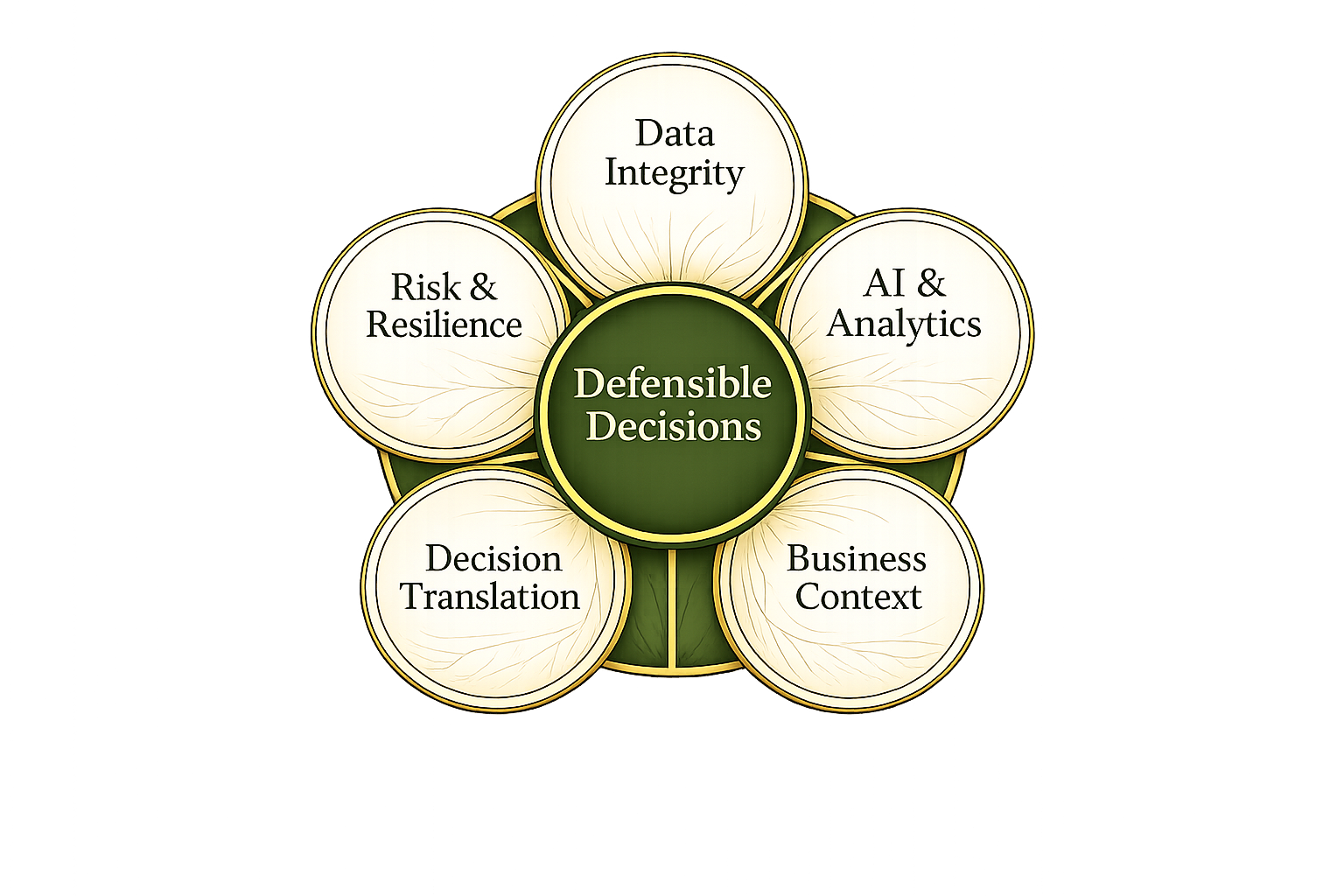
Every engagement draws on all five capabilities, but the emphasis varies depending on the decision.
-
Purpose
Reliable decisions begin with reliable information.
Why it matters
Even sophisticated analysis produces poor recommendations when built on incomplete, inconsistent, or poorly governed data.
How it's applied
• Assess data quality and reliability
• Validate assumptions and key metrics
• Establish consistent definitions and reporting -
Purpose
Use quantitative analysis to illuminate uncertainty—not replace judgment.
Why it matters
Forecasting, modeling, AI, and statistical analysis help leaders understand scenarios, risks, and tradeoffs before committing to a course of action.
How it's applied
• Forecasting and predictive modeling
• Scenario and sensitivity analysis
• AI-assisted analysis and decision support -
Purpose
Every decision must be evaluated within its broader business environment.
Why it matters
Data gains meaning only when interpreted alongside market conditions, organizational priorities, operational realities, and external forces.
How it's applied
• Market and industry assessment
• Economic and competitive analysis
• Organizational and operational considerations -
Purpose
Transform complex analysis into executive-ready guidance.
Why it matters
Analysis creates value only when leaders understand the implications and can act with confidence.
How it's applied
• Executive decision briefs
• Decision frameworks and recommendations
• Clear communication of risks and tradeoffs -
Purpose
Prepare organizations to perform under uncertainty.
Why it matters
The strongest decisions anticipate changing conditions rather than assuming a single expected outcome.
How it's applied
• Risk identification and mitigation
• Scenario planning and contingency analysis
• Long-term resilience planning
Together, these five capabilities create a structured approach for turning complex information into confident, defensible decisions.
Meet the Founder
Rebecca Osakwe founded Magnolia Decision Advisory after more than a decade helping senior leaders navigate complex decisions through economics, analytics, and executive decision support.
Her work has included developing forecasting models, analytical frameworks, executive reporting systems, and decision-support tools across higher education, government, and consulting.
Today, Magnolia Decision Advisory brings that same disciplined approach to organizations operating in complex, uncertain environments—particularly across energy, infrastructure, and economic development.
Rebecca holds a B.A. in Economics from Stanford University and an M.S. in Agricultural & Resource Economics from the University of California, Davis.

From Analysis to Action
Data alone rarely resolves difficult decisions.
The challenge is understanding uncertainty, weighing tradeoffs, and translating evidence into practical action.
Magnolia Decision Advisory exists to bridge that gap—combining economics, analytics, market intelligence, and structured reasoning into guidance leaders can confidently act upon.
Interested in discussing a complex strategic decision?